Volume 1
Handbook of American Indian languages / by Franz Boas ; with illustrative sketches by Roland B. Dixon ... [and others].
- Franz Boas
- Date:
- 1911-
Licence: Attribution-NonCommercial 4.0 International (CC BY-NC 4.0)
Credit: Handbook of American Indian languages / by Franz Boas ; with illustrative sketches by Roland B. Dixon ... [and others]. Source: Wellcome Collection.
987/1088 (page 975)
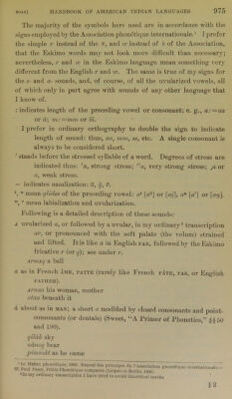
![The majority of the symbols here used are in accordance with the signs employed by the Association phonetique internationale.- I prefer the simple r instead of the and w instead of b of the Association, that the Eskimo words msi}^ not look more dithcult than necessary; nevertheless, r and w in the Eskimo language mean something very different from the English r and w. The same is true of my signs for the s- and a- sounds, and, of course, of all the uvularized vowels, all of which only in part agree with sounds of any other language that I know of. : indicates length of the preceding vowel or consonant; e. g., a; = aa or a; m:—mm or m. I prefer in ordinary orthography to double the sign to indicate length of sound: thus, aa, mm, ss, etc. A single consonant is always to be considered short. ' stands before the stressed syllable of a word. Degrees of stress are indicated thus: 'a, strong stress; a, very strong stress; or a, weak stress. ~ indicates nasalization: a, q, f. *, “ mean glides of the preceding vowel: a* [a“] or [ai\, a“ [a’] or [au], ’■ mean labialization and uvularization. Following is a detailed description of these sounds: A uvularized a, or followed by a uvular, in my ordinary* transcription ar, or pronounced with the soft palate (the velum) strained and lifted. It is like a in English far, followed by the Eskimo fricative ?' (or j); see under ?\ ArssAq a ball a as in French ame, patte (rarely like French pIte, pas, or English father). Arnaa his woman, mother ataa beneath it d about as in man; a short a modified by closed consonants and point- consonants (or dentals) (Sweet, “A Primer of Phonetics,” §§50 and 190). qilah sky nanuq bear pimmdt as he came Cf principes de I'Association phondtique internationale.- U. Paul Passy, Petite Phondtique compartSe (Leipsic et Berlin, 1906) > In my ordinary transcription I have tried to avoid diacritical marks. §2](https://iiif.wellcomecollection.org/image/b24881831_0001_0987.jp2/full/800%2C/0/default.jpg)