Volume 1
Handbook of American Indian languages / by Franz Boas ; with illustrative sketches by Roland B. Dixon ... [and others].
- Franz Boas
- Date:
- 1911-
Licence: Attribution-NonCommercial 4.0 International (CC BY-NC 4.0)
Credit: Handbook of American Indian languages / by Franz Boas ; with illustrative sketches by Roland B. Dixon ... [and others]. Source: Wellcome Collection.
990/1088 (page 978)
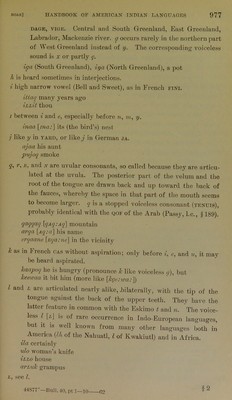
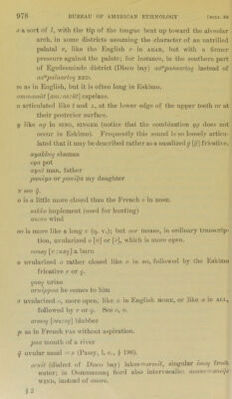
![a sort of I, with the tip of the tongue bent up toward the alveolar arch, in some districts assuming the character of an untrilled palatal r, like the English r in arab, but with a firmer pressure against the palate; for instance, in the southern part of Egedesminde district (Disco bay) aaFpaJ>aavtoq instead of aa'^palaartoq red. m as in English, but it is often long in Eskimo. ainnumiit \^am:as:dt\ capelans. n articulated like t and x, at the lower edge of the upper teeth or at their posterior surface. y like ng in sing, singer (notice that the combination yg does not occur in Eskimo). Frequently this sound is so loosely articu- lated that it may be described rather as a nasalized g [^] fricative. ayakkoq shaman 67ja pot ayut man, father paniya or paniga my daughter jv see q. 0 is a little more closed than the French o in rose. sakko implement (used for hunting) ano7'e wind 00 is more like a long u (q. v.); but oor means, in ordinary transcrip- tion, uvularized o [oj or [»], which is more open. ooneq \u:nEq} a burn 0 uvularized o rather closed like o in so, followed by the Eskimo fricative r or q. qooq urine ornippua he comes to him 0 uvularized more open, like o in English more, or like a in all, followed by r or q. See o, o. orssoq \ors:oq'\ blubber p as in French i*as without aspiration. paa mouth of a river q uvular nasal =n (Passy, 1. c., § 196). ei'Nit (dialect of Disco ba3^) lakes=m/2?’^, singular imeq fresh water; in Oommannaq fiord also intervocalic: anoNe=aiwqe WIND, instead of anoi'e. §2](https://iiif.wellcomecollection.org/image/b24881831_0001_0990.jp2/full/800%2C/0/default.jpg)