Volume 1
Handbook of American Indian languages / by Franz Boas ; with illustrative sketches by Roland B. Dixon ... [and others].
- Franz Boas
- Date:
- 1911-
Licence: Attribution-NonCommercial 4.0 International (CC BY-NC 4.0)
Credit: Handbook of American Indian languages / by Franz Boas ; with illustrative sketches by Roland B. Dixon ... [and others]. Source: Wellcome Collection.
991/1088 (page 979)
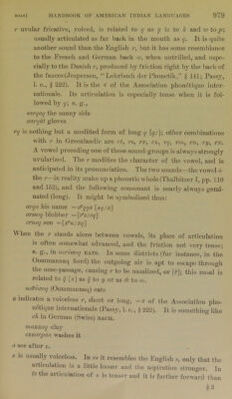
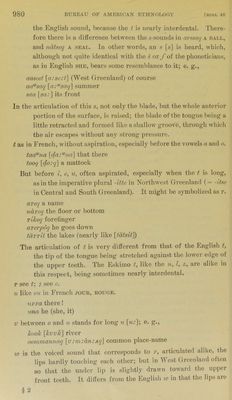
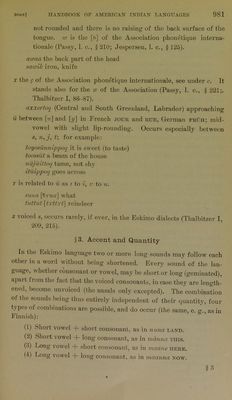
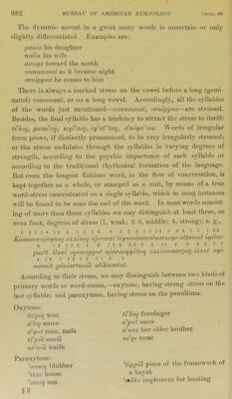
![r uvular fricative, voiced, is related to <7 as <7 is to k and w io p\ usually articulated as far back in the mouth as q. It is quite another sound than the English ?*, but it has some resemblance to the French and German back -?% when untrilled, and espe- cially to the Danish r, produced by friction right by the back of the fauces (Jespersen, “Lohrbuch der l^honetik,” § 141; Passy, 1. c., § 222). It is the ‘n of the Association phonetique inter- nationale. Its articulation is esjiecially tense when it is fol- lowed by e. g., sarqaq the sunny side aarqat gloves rq is nothing but a modified form of long q [^.-]; other combinations with r in Greenlandic are rt, rs, tf, tl, rq, rm, rn, ry, vn. A vowel preceding one of these sound-groups is always strongly uvularized. The r modifies the character of the vowel, and is anticipated in its pronunciation. The two sounds—the vowel -t- the r—in reality make up a phonetic whole (Thalbitzer I, pp. 110 and 152), and the following consonant is nearly always gemi- nated (long). It might be symbolized thus: arqa his name =a^qqa {Aq:a\ orssoq blubber = {o’'s:oq'\ ei'neq son =[E^n:Eq'\ When the r stands alone between vowels, its place of articulation is often somewhat advanced, and the friction not very tense; e. g., in net'iwoq eats. In some districts (for instance, in the Oommannaq fiord) the outgoing air is apt to escape through the nose-passage, causing r to be nasalized, or [r]; this nasal is related to q [w] as y to ^ or as w to m. nenwoq (Oommannaq) eats R indicates a voiceless r, short or long, = 21 of the Association pho- netique internationale (Passy, 1. c., § 222). It is something like ch in German (Swiss) bach. maRRciq clay eRRorpaa washes it see after l. s IS usually voiceless. In rs it resembles the English s, only that the articulation is a little looser and the aspiration stronger. In ts the articulation of s is tenser and it is farther forn-ard than](https://iiif.wellcomecollection.org/image/b24881831_0001_0991.jp2/full/800%2C/0/default.jpg)