Volume 1
Handbook of American Indian languages / by Franz Boas ; with illustrative sketches by Roland B. Dixon ... [and others].
- Franz Boas
- Date:
- 1911-
Licence: Attribution-NonCommercial 4.0 International (CC BY-NC 4.0)
Credit: Handbook of American Indian languages / by Franz Boas ; with illustrative sketches by Roland B. Dixon ... [and others]. Source: Wellcome Collection.
999/1088 (page 987)
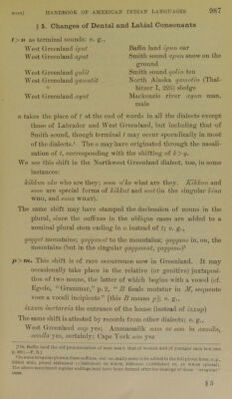
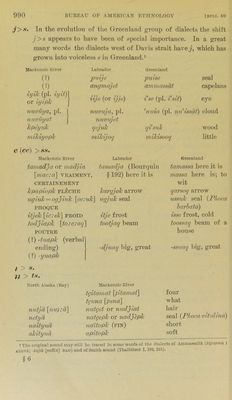
![§ 5. Changes of Dental and Labial Consonants as terminal sounds: e. g., West Greenland iput West Greenland aput West Greenland qulit West Greenland qamutit West Greenland ayut Baffin land ip%m oar Smith sound apim snow on the ground Smith sound qolin ten North Alaska qamotin (Thal- bitzer I, 225) sledge Mackenzie river ayun man, male n takes the place of t at the end of words in all the dialects except those of Labrador and West Greenland, but including that -of Smith sound, though terminal t ma\’ occur sporadically in most of the dialects. ‘ The n may have originated through the nasali- zation of corresponding with the shifting of k>y. We see this shift in the Northwest Greenland dialect, too, in some instances: Ml'Jcun xiko who are they; soon u'Tco what are they, Kikkun and soon are special forms of kikkut and soot (in the singular kina WHO, and suna what). The same shift may have stamped the declension of nouns in the plural, since the suffixes in the oblique cases are added to a nominal plural stem ending in n instead of t\ e, g,, qaqqat mountains; qaqqanut to the mountains; qaqqane in, on, the mountains (but in the singular qaqqamut, qaqqameY p > m. This shift is of rare occurrence now in Greenland. It may occasional 1}'^ take place in the relative (or genitive) juxtaposi- tion of two nouns, the latter of which begins with a vowel (cf. Egede, ‘‘Grammar,” p. 2, finale mutatur in sequeute voce a vocali incipiente” [this B means y?]; e. g., zLLvm iset'tavFia the entrance of the house (instead of iLLup) The same shift is attested b}*^ records fi'om other dialects; e. g.. West Greenland yes; Ammassalik aam or eem in aamila, eemila yes, certainly; Cape York eem yes [’In Battln land the old pronunciation of men was t; that of women and of younger men is n (see p. 985).—F. B.] ’ In some irregular plurals these sufTlxes, -nul -ne, really seem to be added to the full plural form; e. g., kikkut WHO, plural kikkunnut {<,kikkutnut) to WHOSt, kikkunue (dkikkutne) in, at wiio.m (plural). 1 he above-mentioned regular endings may have been formed after the analogy of these irregular ” ones. §5](https://iiif.wellcomecollection.org/image/b24881831_0001_0999.jp2/full/800%2C/0/default.jpg)