The historie of Cambria, now called Wales: a part of the most famous Yland of Brytaine / written in the Brytish language above two hundreth yeares past: translated into English by H. Lhoyd Gentleman: corrected, augmented, and continuted out of records and best approoved authors, by David Powel.
- Caradoc of Llancarfan
- Date:
- 1584
Licence: Public Domain Mark
Credit: The historie of Cambria, now called Wales: a part of the most famous Yland of Brytaine / written in the Brytish language above two hundreth yeares past: translated into English by H. Lhoyd Gentleman: corrected, augmented, and continuted out of records and best approoved authors, by David Powel. Source: Wellcome Collection.
45/472 page 19
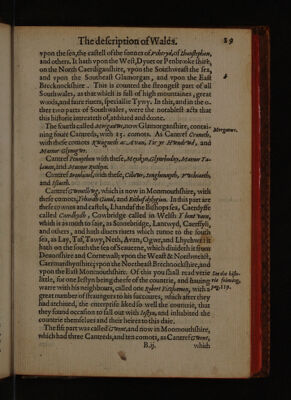
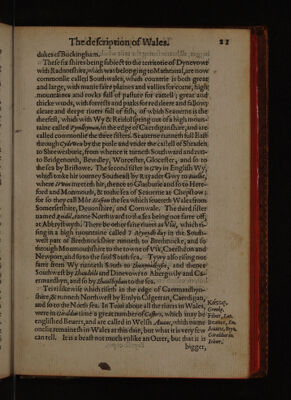
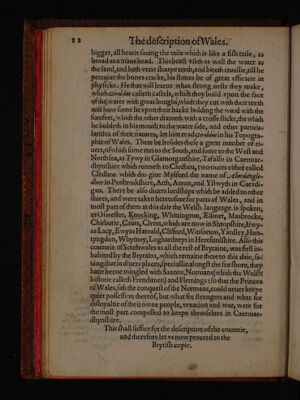
![vpon the ſea, the caſtell of the ſonnes of htm d, of Lhanftephan, and others. It hath vpon the Weſt, Dyuet or Penbrooke thire, on the North Caerdiganfhire, vpon the Southweaſt the fea, and vpon the Southeaſt Glamorgan , and vpon the Eaſt Brecknockthire .. This is counted the ſtrongeſt part of all South wales, as thatwhich is full of high mountaines , great woods, and faire riuers, ſpeciallie Tywy. In this, and in the o- ther two parts of Southwales, were the notableſt acts that this hiſtorie intreateth of, atchiued and done. The fourth called aan e, now Glamorganſhire, contai- ning foure Cantreds, with 15. comots. As Cantref Croneth, wick theſe comots RWwugneth ac A van, Tir yr Andr wd, and MaenorGlynog vr. Cantref Pennythen with theſe, Meyohyn, Olynrhodny, Matnor Ta- gauan, and Ataenor Rubin. Cantref Brenlunol, with thieſe, Cilowr, Senghennyth, vw cheaetß, and fuebocs cogy bar. isi | CantrefGwentlh wg, whichis now in Monmouthfhire, with thefe cots] e Ganol, and Esthafdylygion. In this part are thefecownes and caftels, Lhandaf the Bithops fea, Caerdyffe called Czerdhydh , Cowbridge called in Welth I Lent vaen, which is as much to faie, as Stonebridge, Lantwyd, Caerffyli, and others, and hath diuers riuers which runne to the fouth fea,as Lay, Taf, Tawy, Neth, Avan; Ogwr,and Lhychwetit hath on the ſouth the fea of Seauerne, which diuideth it from Deuonthire and Cornewall; vpon the Weaſt & Northweatt, Caermardhynſſiireʒvpon the Northeaſt Brechnockſhire, and ypon the Eaſt Monmouthfhire. Of this you fhall read verie Ste the hifo- - little, for one Ieftyn being cheefe of the countrie, and hauing rie filmi, warre with his neighbours, called one Robert Firzhamon, with a HN. great number of ſtraungers to his ſuccoures, which after they had atchiued, the enterprife liked ſo well the countrie, that they found occaſion to fall out with 75h, and inhabited the countrie themſelues and their heires to this daie. The fift part was called Gent, and now in Monmouthſhire, which had three Cantreds, and ten comots, as Cantref G went, B. ij. which Morgane. *](https://iiif.wellcomecollection.org/image/b30329838_0045.jp2/full/800%2C/0/default.jpg)
 No text description is available for this image
 No text description is available for this image
 No text description is available for this image