A smaller atlas of illustrations of clinical surgery / by Jonathan Hutchinson.
- Jonathan Hutchinson
- Date:
- 1895
Licence: Public Domain Mark
Credit: A smaller atlas of illustrations of clinical surgery / by Jonathan Hutchinson. Source: Wellcome Collection.
22/560
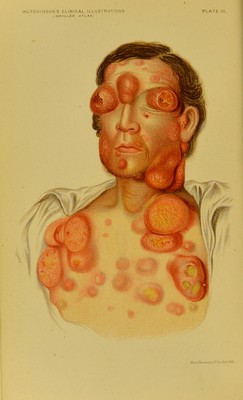
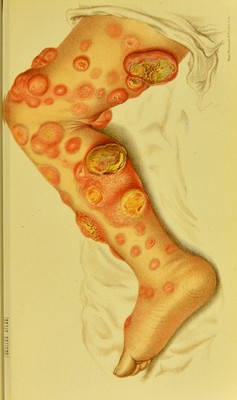
![substituted. The eruption had been steadily getting worse the whole time, but as it had been throughout considered to be syphilitic the specific had been pressed. On careful enquiry I did not think that there was much reason to suspect that the man had really had syphilis. He lived for about a fortnight after the iodide had been completely left off, but during this time no material change occurred in the eruption. He was in an extremely feeble condition the whole time; and his death was from exhaustion. The microscope was carefully used, but revealed nothing of importance. In the Guy's Hospital Museum there is a model (No. 117), which may perhaps belong to a closely similar case. Some of the tubers were as large as plums, and one of them even measured two inches across. Unfortunately no history is obtainable. I was indebted to my friend the late Dr. Hilton Fagge, the author of the Catalogue of the Guy's Collection, for drawing my attention to the close similarity between this model and my own case. I cannot but suspect that not a few cases which have been classed as cutaneous gummata in connection with syphilis have been really examples of iodide of potassium eruption, and I can call to mind several in bygone years in which patients died with severe eruptions of an anomalous character which were not improbably due to this cause. The frontispiece to Dr. Prince Morrow's (New York) work on 'Eruptions due to Drugs' shows the conditions in a fatal case of iodide poisoning. In it the tubers were not so large as in mine, but the inflammation of skin was more diffuse. Death was caused by a much smaller quantity of the drug than in my case. Not only is it necessary in the diagnosis of syphilitic gummata of the skin to first eliminate iodide eruptions, but the same remark applies to the various conditions which have been grouped together under the name of Granuloma Fungoides. [The Clinical Museum is now rich in illustrations of iodide eruptions, and these two portraits, which were regarded twenty years ago with much incredulity as to the diagnosis, are now well supported.]](https://iiif.wellcomecollection.org/image/b2039472x_0022.jp2/full/800%2C/0/default.jpg)