The antiquity of cremation and curious funeral customs / [Albert C. Freeman].
- Freeman, Albert C.
- Date:
- [1909?]
Licence: In copyright
Credit: The antiquity of cremation and curious funeral customs / [Albert C. Freeman]. Source: Wellcome Collection.
32/112 page 28
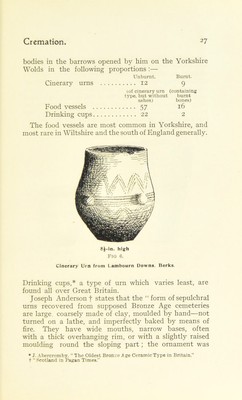
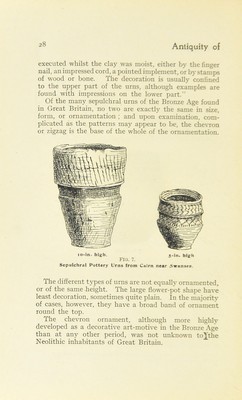
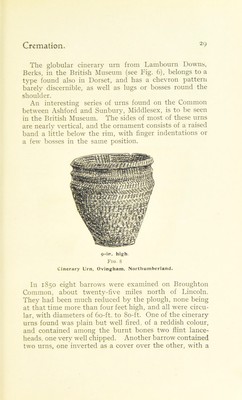
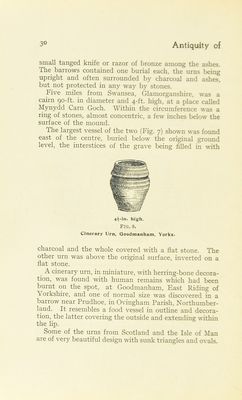
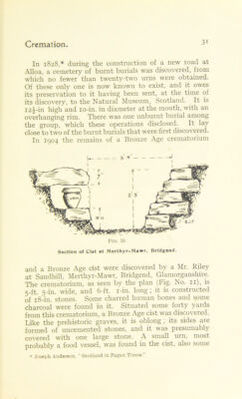
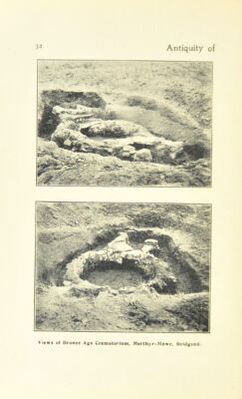
![executed whilst the clay was moist, either by the finger nail, an impressed cord, a pointed implement, or by stamps of wood or bone. The decoration is usually confined to the upper part of the urns, although examples are found with impressions on the lower part.” Of the many sepulchral urns of the Bronze Age found in Great Britain, no two are exactly the same in size, form, or ornamentation ; and upon examination, com- plicated as the patterns may appear to be, the chevron or zigzag is the base of the whole of the ornamentation. io-in. high. s.i„. high Fig. 7. Sepulchral Pottery Urns from Cairn near Swansea. The different types of urns are not equally ornamented, or of the same height. The large flower-pot shape have least decoration, sometimes quite plain. In the majority of cases, however, they have a broad band of ornament round the top. The chevron ornament, although more highly developed as a decorative art-motive in the Bronze Age than at any other period, was not unknown to][the Neolithic inhabitants of Great Britain](https://iiif.wellcomecollection.org/image/b24869338_0032.jp2/full/800%2C/0/default.jpg)
 No text description is available for this image
 No text description is available for this image
 No text description is available for this image