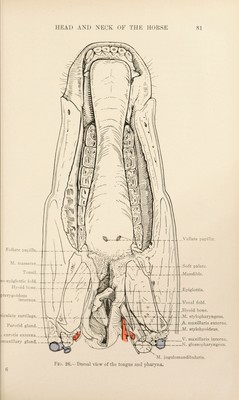
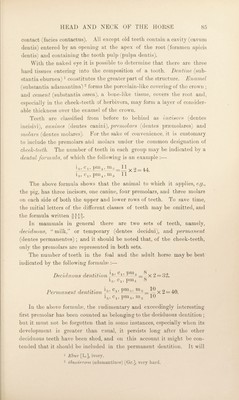
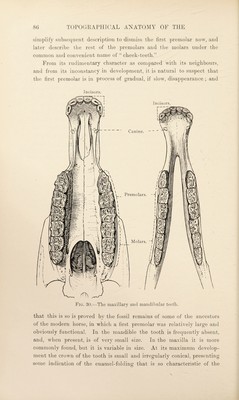
The topographical anatomy of the head and neck of the horse / [O. Charnock Bradley].
- Orlando Charnock Bradley
- Date:
- 1923
Licence: In copyright
Credit: The topographical anatomy of the head and neck of the horse / [O. Charnock Bradley]. Source: Wellcome Collection.
100/248 page 84
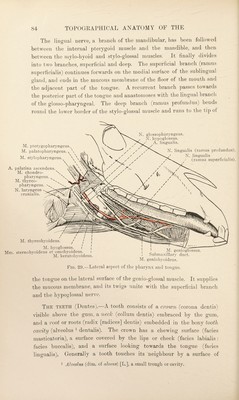
![The Unequal nerve, a branch of the mandibular, has been followed between the internal pterygoid muscle and the mandible, and then between the mylo-hyoid and stylo-glossal muscles. It finally divides into two branches, superficial and deep. The superficial branch (ramus superficialis) continues forwards on the medial surface of the sublingual o;land, and ends in the mucous membrane of the floor of the mouth and the adjacent part of the tongue. A recurrent branch passes towards the posterior part of the tongue and anastomoses with the lingual branch of the glosso-pharyngeal. The deep branch (ramus profundus) bends round the lower border of the stylo-glossal muscle and runs to the tip of the tongue on the lateral surface of the genio-glossal muscle. It supplies the mucous membrane, and its twigs unite with the superficial branch and the hypoglossal nerve. The teeth (Dentes).—A tooth consists of a crown (corona dentis) visible above the gum, a neck (collum dentis) embraced by the gum, and a root or roots (radix [radices] dentis) embedded in the bony tooth cavity (alveolus ^ dentalis). The crown has a chewing surface (facies masticatoria), a surface covered by the lips or cheek (facies labialis : facies buccalis), and a surface looking towards the tongue (facies lingualis). Generally a tooth touches its neighbour by a surface of 1 Alveolus (dim. of alveus) [L.], a small trough or cavity.](https://iiif.wellcomecollection.org/image/b29820066_0100.jp2/full/800%2C/0/default.jpg)