The topographical anatomy of the head and neck of the horse / [O. Charnock Bradley].
- Orlando Charnock Bradley
- Date:
- 1923
Licence: In copyright
Credit: The topographical anatomy of the head and neck of the horse / [O. Charnock Bradley]. Source: Wellcome Collection.
105/248 page 89
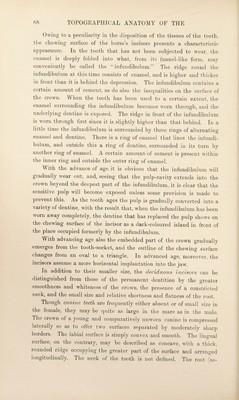
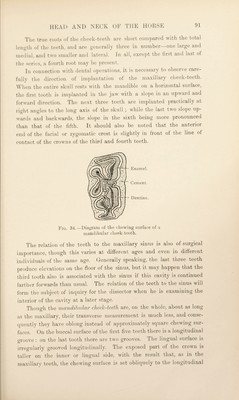
![called) is conical, curved and well developed, being, in the young animal, two or three times the length of the exposed crown. With age the exposed crown becomes gradually converted into a blunt cone. Jn both the upper and lower jaw there is an interdental space between the incisors and the canines, but the interval is less in the mandible than in the upper jaw. Thus the mandibular canine bites in front of the maxillary tooth, as is the arrangement in mammalia in ireneral. o Fig. 32.—Diagram of a longitudinal section of a maxillary cheek-tooth. Deciduous canines occur in both the male and the female, but they’’ are always rudimentary and do not erupt. The ma.xillary cJceek-teeth ^ are large and possessed of long crowns, the major part of which, in the young tooth, is embedded in the jaw. As wear proceeds the embedded part of the crown emerges, and thus ensures the preservation of a uniform length of tooth above the gum. With the exception of the first, each tooth is in the form of a slightly bent four-sided prism, the first being three-sided in conseipience of the ^ Since the first ])reniolar wa.s descrilied earlier (page 8G), it is not included in tlie above description. What are here named the first, second and third “cheek- teetli” are, therefore, the .second, third and fourth preniolars.](https://iiif.wellcomecollection.org/image/b29820066_0105.jp2/full/800%2C/0/default.jpg)