The topographical anatomy of the head and neck of the horse / [O. Charnock Bradley].
- Orlando Charnock Bradley
- Date:
- 1923
Licence: In copyright
Credit: The topographical anatomy of the head and neck of the horse / [O. Charnock Bradley]. Source: Wellcome Collection.
33/248 page 17
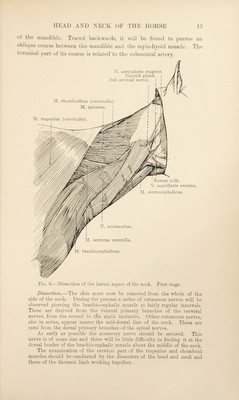
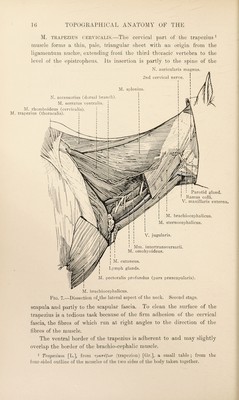
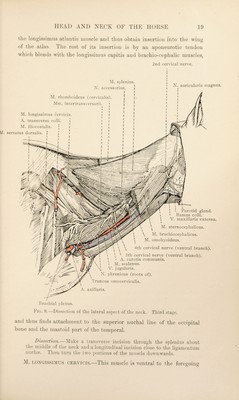
![Dissection.—The tra])eziiis muscle sliouhl ])e reflected after an incision has been made througli it close to its origin from tlie ligamentum nuchcC. N. ACCESSORIUS.—At a later stage in the dissection it will be found that the accessory or eleventh cerebral nerve divides into two branches ventral to the wing of the atlas. The tciwis veiitvalis; has already been seen to enter the sterno-cephalic muscle not far from its tendon of insertion. Ihe vavius dor.^alis, now being investigated, receives branches from the second and third cervical nerves in its course along the neck under cover of the bracliio-cephalic muscle. It reaches the doisal border of this muscle and travels along it for a short distance. Covered by the cervical part of the trapezius, the ramus pursues a wavy course over the ventral serrate (cervical part), deep pectoral (prescapular part) and supraspinous muscles, to end in the thoracic part of the trapezius. M. RHOMBOIDEUS CERVICALIS.—The rounded cervical rhomboid ^ muscle arises, by short bundles of tendinous fibres, from the ligamentum nuchfe from the level of the second cervical to the second thoracic vertebra. It has a thin, narrow, pointed extremity opposite the epi¬ stropheus and increases in volume as its insertion to the medial surface of the scapular cartilage is approached. M. BRACHiocEPHALicus.'—It is generally accepted that the sterno- cleido-mastoid muscle of man is represented in the horse by two distinct muscles—the sterno-cephalic, already examined, and the brachio-cephalic. Owing to degeneration of the clavicle, the clavicular part of the deltoid muscle of the human body is moreover represented in that part of the horse’s brachio-cephalic^ that extends from the level of the shoulder joint to the humeral attachment of the muscle. In this connection it should be noted that it is generally possible to find the trace of a transverse tendinous intersection, representing the clavicle, in the brachio-cephalic muscle opposite the shoulder joint. Tlie fact that the accessory nerve supplies the sterno-cephalic and a part of the brachio-cephalic, and that the axillary nerve supplies the humeral end of the brachio-cephalic, lends support to the view stated above. The brachio-cephalic muscle has attachments to the ridge forming the lateral boundary of the groove on the humerus, the fascia of the arm, the transverse processes of the second, third and fourth cervical ^ Rhombu,<i [L.], pd/x^os (rhoinbos) [Gr.], a rhoml;. eldos (eidos) [Gr.], form. 2 Brachium [L.], (brachioii) [Gr.], the arm above the elbow. Ce2)halicus [L.], K€(pa\iK6s (ce])halicos) [Gr.], pertaining to the head (KccpaX-q).](https://iiif.wellcomecollection.org/image/b29820066_0033.jp2/full/800%2C/0/default.jpg)