The topographical anatomy of the head and neck of the horse / [O. Charnock Bradley].
- Orlando Charnock Bradley
- Date:
- 1923
Licence: In copyright
Credit: The topographical anatomy of the head and neck of the horse / [O. Charnock Bradley]. Source: Wellcome Collection.
45/248 page 29
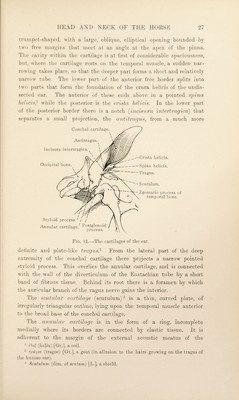
![The loiKj ahductor arises from the ligamentnm nuchm and is inserted into the posterior and lateral part of the conchal cartilage below the level of the incisura intertragica. The sliort (ihductov lies beneath the long muscle, in common with which it arises from the lioramentum nuchie. It is inserted into the o conchal cartilage close to the base of its st}doid ])rocess. Mm. auricularrs saperiores.—The superior group of muscles includes a short and a middle levator. The sitorf levator is narrow and arises from the surface of the scutular cartilage. It crosses obliquely underneath one of the anterior auricular muscles (the fourth as described above) to be inserted into the medial surface of the conchal cartilage. The middle levator lies under cover of the interscutular and long levator muscles. Its origin is from the external sagittal crest, and its insertion is into the medial surface of the conchal cartilage. Dissection.—Reflect the middle levator and the long abductor muscles. Mm. auricidares profundi.—The deep auricular muscles are rotators—long and short—which cross each other and pass from the deep surface of the scutular cartilage to the concha. ^[. tragicus.—To expose this muscle a considerable volume of fat in the region of the conchal cartilage must be removed. The muscle is small and narrow. Its origin is from the posterior aspect of the bony wall of the external acoustic meatus and the annular cartilage, and its insertion is into the basal part of the conchal cartilage. Intrinsic muscles.—Three very rudimentary and unimportant intrinsic muscles are described. M. antitragicns lies on the conchal cartilage close to the point at which its free borders meet. M. helicis occupies a similar level on the anterior border of the cartilage and extends into the hollow between the crura helicis. The two foregoing muscles are partly continuous with the inferior auricular muscle. M. verticalis auricvdcc consists of a few muscular and tendinous bundles on the convex surface of the conchal cartilage. The arteries of the ear.—Only the terminal part of the vessels that furnish blood to the external ear can be examined at the present stage of the dissection. Their origin and an appreciable part of their course are hidden by the parotid gland. A. aiiricularis jgosterior.—The main artery of the external ear is the posterior auricular, a branch of the external carotid. Beginning on a level with the great cornu of the hyoid bone, this artery runs under the parotid gland to the base of the ear, but its origin and the first part of its course must not be sought at present. Those branches of the artery that supply the ear are as follows:—](https://iiif.wellcomecollection.org/image/b29820066_0045.jp2/full/800%2C/0/default.jpg)