The topographical anatomy of the head and neck of the horse / [O. Charnock Bradley].
- Orlando Charnock Bradley
- Date:
- 1923
Licence: In copyright
Credit: The topographical anatomy of the head and neck of the horse / [O. Charnock Bradley]. Source: Wellcome Collection.
57/248 page 41
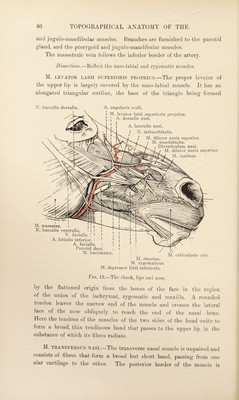
![definite ; but the anterior border blends witli the orbicular muscle of the lip. The superficial fibres of the transverse muscle are attached to the laminae of the alar cartilages ; while the deeper fibres are connected with the cornua of the cartilages and the incisive bones. M. L ATEiiALis NASI.—Tlie lateral nasal muscle consists of diffuse, pale fibres springing from the bony boundary of the naso-maxillary notch and ending in the wall of the vestibule of the nose. From the position and direction of its fibres, the muscle may be divided into four parts. (1) The dorsal part consists of fibres arising from the free border of the nasal bone. (2) The posterior part springs from the neighbour¬ hood of the angle formed by the union of the nasal and incisive bones. (8) The inferior part has origin from the nasal process of the incisive bone. (4) The anterior part consists of a few fibres attached to the concavity of the cornu of the alar cartilage. N. INFRAOKBITALLS.—The infra-orbital nerve is the terminal branch of the nervus maxillaris (a part of the fifth cerebral nerve) and, in the present dissection, appears at the infra-orbital foramen after having traversed the infra-orbital canal. Immediatelv on its emerwnce from O the foramen, it divides into three branches. (1) The external nasal branch (ramus nasalis externus) accompanies the levator labii superioris proprius and divides into two or three branches that supply the wall of the diverticulum of the nostril and the dorsum of the nose. (2) The anterior nasal branch (ramus nasalis anterior), larger than the preceding, burrows between the ventral part of the lateral nasal muscle and the nasal process of the incisive bone, to end in the lining of the nostril and the skin of the upper lip. (8) The superior labial branch, (ramus labialis superioris) is the largest of the three divisions of the infra-orbital nerve. It runs obliquely downwards and forwards under the naso-labial muscle to reach the upper lip, in the skin and mucous membrane of which it ends. Delicate filaments are distributed to the tactile- or sinus-hairs of the lip. The superior labial branch is connected with the dorsal buccal nerve by one or two curved communicating branches, and there is frequent union between the branches of the two nerves in the substance of the lip. Dissection.—Exi)ose the surface of the })arotid gland by the removal of the inferior auricular muscle, the very thin cutaneous muscle, and the layer of fa.scia covering the gland. Care must he exercised iiot to injure the small ramus colli of the facial (seventli cerebral) nerve, wliich should be found ])iercing the gland aljout its middle.](https://iiif.wellcomecollection.org/image/b29820066_0057.jp2/full/800%2C/0/default.jpg)