The topographical anatomy of the head and neck of the horse / [O. Charnock Bradley].
- Orlando Charnock Bradley
- Date:
- 1923
Licence: In copyright
Credit: The topographical anatomy of the head and neck of the horse / [O. Charnock Bradley]. Source: Wellcome Collection.
59/248 page 43
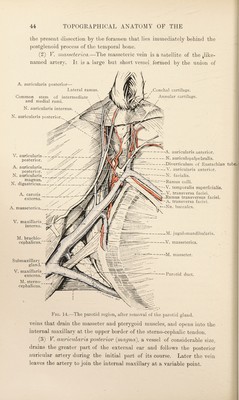
![Dissecfwyi.—I'lie puiotid ,u:lan(l must now ])p i-enioved hit hy hit. It is necessary to coiidncL tlie dissection in tins nianiKM' in order to avoid injury to the nnnierous structures, some of wliich are small, related to the gland. It is further advisable to secure the various vessels and nerves of the region as soon as possible, and follow them under or through the gland. A small group of lymph glands should be looked for close to the man¬ dibular joint. M. STERXOCEPHALtcus.—The Hatteiied tendon of the sterno-cephalic muscle can now be completely examined. Its connection with the tendon of the brachio-ce})halic muscle by an aponeurotic sheet of tissue should also be noted. M. JUGULOMANDitJULAiiLS.—The strong jugulo-mandibular muscle arises from the anterior margin of the jugular process of the occipital bone, runs obliquely downwards and forwards, and is inserted to the posterior border of the ramus of the mandible. V. MAXILLARLS INTERNA.— For the Sake of convenience, the internal maxillary vein may be divided into two parts. The first })art lies within the mandible, and cannot be examined as yet. The second part of the vein, now exposed, is a large vessel that makes its appearance at about the junction of the middle and upper thirds of the mandibular ramus. From this point it runs downwards and backwards, at first nearly parallel to the border of the mandible, and afterwards over the lateral surface of the jugulo-mandibular muscle. Then, by piercing the p)arotid gland, it gains its lateral surface along which it travels to the posterior ventral angle of the gland, where it unites with the external maxillary vein to form the jugular. The relation of the vein to the parotid is subject to considerable variation. Sometimes the passage of the vein through the gland is abrupt ; at other times it is so gradual that only the very end of the vessel is visible before the parotid is removed. The tributaries of the second part of the internal maxillary vein are as follows;— (1) F. te'/ivpot'ctlis siope}‘Jici(tlis, a ssitell ite of the superficial temporal artery, is formed by the union of the transverse facial (v. transversa faciei) and anterior auricuLar (v. auricularis anterior) veins. The first- named follows the dorsal border of the transverse facial artery. It has already been noted that the anterior auricular vein is a satellite of the artery of the same name, and that its terminal part is large because it is joined by the superior cerebral vein, one of the efHuents of the system of venous sinuses within the cranium. The superior cerebral vein (v. cerebralis superior) traverses the temporal meatus and enters](https://iiif.wellcomecollection.org/image/b29820066_0059.jp2/full/800%2C/0/default.jpg)