The spirit of modern philosophy : an essay in the form of lectures / by Josiah Royce.
- Josiah Royce
- Date:
- 1892
Licence: Public Domain Mark
Credit: The spirit of modern philosophy : an essay in the form of lectures / by Josiah Royce. Source: Wellcome Collection.
Provider: This material has been provided by the Francis A. Countway Library of Medicine, through the Medical Heritage Library. The original may be consulted at the Francis A. Countway Library of Medicine, Harvard Medical School.
498/550 (page 474)
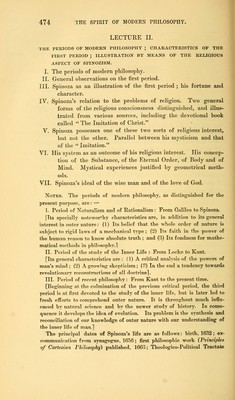
![LECTURE II. THE PERIODS OF MODERN PHILOSOPHY ; CHARACTERISTICS OF THE FIRST PERIOD ; ILLUSTRATION BY MEANS OF THE RELIGIOUS ASPECT OF SPINOZISM. I, The periods of modern plailosopbj. II. General observations on the first period. III. Spinoza as an illustration of the first period ; his fortune and character. IV. Spinoza's relation to the problems of religion. Two general forms of the religious consciousness distinguished, and illus- trated from various sources, including the devotional book called The Imitation of Christ. V. Spinoza possesses one of these two sorts of religious interest, but not the other. Parallel between liis mysticism and that of the Imitation. VI. His system as an outcome of his religious interest. His concep- tion of the Substance, of the Eternal Order, of Body and of Mind. Mystical experiences justified by geometrical meth- ods. VII. Spinoza's ideal of the wise man and of the love of God. Notes. The periods of modern philosophy, as distingnished for the present purpose, are: — I. Period of Naturalism and of Rationalism : From Galileo to Spinoza. [Its specially noteworthy characteristics are, in addition to its general interest in outer nature: (1) Its belief that the whole order of nature is subject to rig-id laws of a mechanical type ; (2) Its faith in the power of the human reason to know absolute truth ; and (3) Its fondness for mathe- matical methods in philosophy,] II. Period of the study of the Inner Life : From Locke to Kant. [Its general characteristics are : (1) A critical analysis of the powers of man's mind ; (2) A growing skepticism; (8) In the end a tendency towards revolutionary reconstructions of all doctrine]. III. Period of recent philosophy: From Kant to the present time. [Beginning at the culmination of the previous critical period, the third period is at first devoted to the study of the inner life, but is later led to fresh efforts to comprehend outer nature. It is throughout much influ- enced by natural science and by the newer study of history. In conse- quence it develops the idea of evolution. Its problem is the synthesis and reconciliation of our knowledge of outer nature with our understanding of the inner life of man.] The principal dates of Spinoza's life are as follows: birth, 1632; ex- communication from synagogue, 1656; first philosophic work (Principles of Cartesian Philosophy) published, 1663; Theologieo-Political Tractate](https://iiif.wellcomecollection.org/image/b21075712_0498.jp2/full/800%2C/0/default.jpg)