The Gaelic names of plants (Scottish, Irish and Manx) / collected and arranged in scientific order, with notes on their etymology, uses, plant superstitions, etc., among the Celts, with copious Gaelic, English, and scientific indices, by John Cameron.
- Cameron, John
- Date:
- 1900
Licence: In copyright
Credit: The Gaelic names of plants (Scottish, Irish and Manx) / collected and arranged in scientific order, with notes on their etymology, uses, plant superstitions, etc., among the Celts, with copious Gaelic, English, and scientific indices, by John Cameron. Source: Wellcome Collection.
31/186 page 9
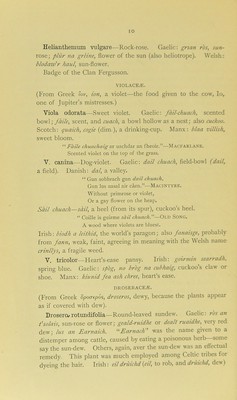
![B. campestris—Wild navew. Gaelic: neup fhiadhain, wild turnip. B. oleracea—Sea-kale or cabbage. Gaelic and Irish: praiseach bhaidhe, the pot-herb of the wave (baidhe, in Irish, a wave). Morran—mor (Welsh), the sea, its habitat the seaside. Cal colbhairt—the kale with stout fleshy stalks (from colbh, a stalk of a plant, and art, flesh), cal or cadhal. Welsh: cawl, kale. Gaelic: cal-cearslach (ccarslack, globular), cabbage; cal gruidhean (with grain like flowers), cauliflower; colag (a little cabbage), cauliflower; garadh call, a kitchen garden. Rotheach tragha (O’Reilly). “ ’Dh ’itheadh biolair an fhuarain ’S air bu shuarach an cal. ”—Macdonald. That would eat the cress of the wells, And consider kale contemptible. Sinapis arvensis—Charlock, wild mustard. Gaelic: marag bhuidhe or amharag, from amh, raw or pungent. Sceallan—sceall, a shield. Sgealag (Shaw)—sgealpach, biting. Mustard—from the English. “ Mar ghr&inne de shlol mustaird.”—Stuart. Like a grain of mustard-seed. The mustard of Scripture, “Salvadora persica'f was a tree twenty feet high, therefore it could not be our mustard. Cas or Gas- na cotiachta (O’Reilly). Cas an thunnagta (Threl). Gaelic: praiseach garbh, the rough pot-herb. Subularia aquatica—Ruideog is given by O’Donovan “as bogawl, a kind of butterweed growing in bogs (County of Monaghan).” Awl wort. May possibly be from the old Irish name ruit, a dart or short spear. It is a small plant found in shallow edges of alpine ponds and lakes. It rarely exceeds two or three inches in height, leaves cylindrical, slender, and pointed like little awls, hence the name awl wort. RESEDACF,.®. Reseda luteola—Weld, yellow weed. Gaelic: Ins buidhe mor, the large yellow weed. Irish: buidhe mor, the large yellow. Welsh: llysie lliu, dye-wort. Reseda, from Latin resedo. CISTACE/E. (From Greek kGtt], kisle, a box or capsule, from their peculiar capsules. Latin: cist a Gaelic: ciste. Danish: kiste.)](https://iiif.wellcomecollection.org/image/b24879368_0031.jp2/full/800%2C/0/default.jpg)



 No text description is available for this image
 No text description is available for this image
 No text description is available for this image