Lessons in practical hygiene for use in schools / by Alice Ravenhill ; with preface by M.E. Sadler.
- Alice Ravenhill
- Date:
- [1907]
Licence: In copyright
Credit: Lessons in practical hygiene for use in schools / by Alice Ravenhill ; with preface by M.E. Sadler. Source: Wellcome Collection.
Provider: This material has been provided by The University of Leeds Library. The original may be consulted at The University of Leeds Library.
40/762 page 26
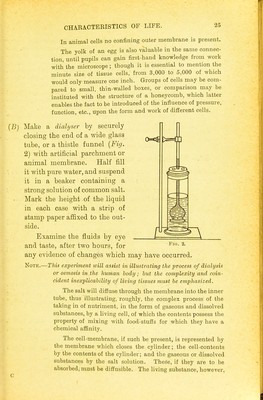
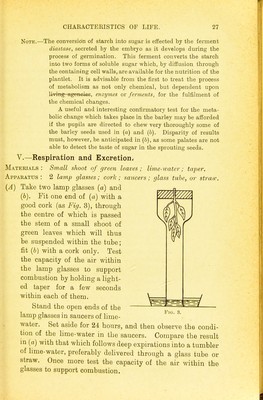
![^ does not pass out of the eel], since the proteid matter (colloid in character) which enters into its composition, con- tain characteristic molecules structurally incapable of pass- ing through the excessively fine pores of the membrane, which, however, affords free passage to the salt molecules. This fact can be demonstrated by filling the dialyser with a solution of white of egg instead of with pure water. It may be well to recall the infinitesimal size of molecules, estimated by Lord Kelvin to vary between a micro-micron and one- tenth of that inconceivably minute dimension. Of their shape, structure and chemical behaviour little is definitely known, but they are endowed with great energy, and the colloid molecules, which are counted among the larger (i.e., from 4—7 ix-fi- in diameter), have actually been seen, under special conditions. IV.—Metabolism a chemical process. Mateeials : Seeds, mustard and cress; Indian corn; barley; nasturtium ; bean, or corn'plant ; leafy shoots ; blotting jjaper; small knife; 10 c.c. iodine solution; cardboard; neutral litmus paper ; white vinegar; thick flannel. Apparatus : Test tubes ; bell-jar ; tumbler, or glass fruit-jar, (A) Grow some small seeds on blotting-paper. When well started, place them in a covered vessel so that the root tips rest upon neutral litmus paper. Drop a little white vinegar upon similar litmus paper, and compare the result with that produced by the root tips after a few hours contact. (J3) Repeat Phenomena of Life I. (Z>). (C) Soak some barley seeds for a few hours in warm water. Divide into two portions (a) and (6), Split {a), and test for the presence of starch as directed in Phenomena of Life, I. (0- Scatter (6) on thick flannel, moistened with warm water, and cover with a fold of flannel. Keep moist and warm (18° C. or 65° F), until the barley is sprouting, i.e., until the rootlet has grown the length of the seed. Test as above with iodine. Eecord any changes indicated by these tests.](https://iiif.wellcomecollection.org/image/b21507089_0040.jp2/full/800%2C/0/default.jpg)