Two monographs on malaria and the parasites of malarial fevers : I. Marchiafava and Bignami. II. Mannaberg.
- Date:
- 1894
Licence: Public Domain Mark
Credit: Two monographs on malaria and the parasites of malarial fevers : I. Marchiafava and Bignami. II. Mannaberg. Source: Wellcome Collection.
Provider: This material has been provided by King’s College London. The original may be consulted at King’s College London.
459/492 page 415
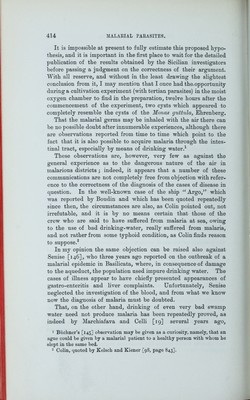
![who permitted six persons to drink water from the Pontine marshes for eight to sixteen days without Seeing one of them attacked by malaria. Two years ago Salomone Marino [147] made similar experiments, also with negative results. That the malarial parasites, or the blood-corpuscles infested by them, can pass through the placenta is proved by the cases in which the foetus has been infected by the suffering mother, as shown by the reports of Dinstl, Schramm, Duchek, and Playfair; the nurse also has been observed to infect the suckling (Schramm, Baxa, and Luc), and the reverse condition has likewise been main- tained (Sons [145]). It may be mentioned here that Dochmann [148] succeeded in inoculating a healthy man with the contents of an herpetic vesicle of a patient suffering from quartan fever, and produced a fever after a few hours* incubation which was of the quartan type ; in the same way he inoculated three men with quotidian fever, once with a positive, twice with a doubtful or negative result. Nothing is up to the present known as to the contents of an herpetic vesicle containing parasites, but after Dochmann’s experi- ments it is highly probable that the parasites must have been in the serum of the vesicle. I have repeatedly investigated sweat without result. It does not lie within the scope of this book to consider the telluric and atmospheric conditions which cause and aid in the production of malaria, but it may be pointed out at this place that the rules which have been gained by a study of those condi- tions, and have been thoroughly appreciated by numerous authors, in no way militate against the supposition of a living malarial virus. The most important conditions under which malaria breaks out are, as is well known, slight porosity of the soil, moderate moisture and warmth, and indeed most authorities on malaria state that a rainy spring and a warm but not too hot summer following, which does not completely dry the soil, results in the appear- ance of far more numerous and severe cases of malaria than when the opposite conditions obtain. In our climate the most severe malarial season is August and September; in tropical countries, as for instance in Algiers and Tunis, September and October (see Kelsch and Kiener, loc. cit., p. 816). It must, indeed, be admitted that those circumstances which have been named as favouring malaria completely agree with the conditions which present the best opportunity for growth to a low organism having either a parasitic or saprophytic character. Finally, concerning the incubation of malaria, we know that](https://iiif.wellcomecollection.org/image/b21303563_0459.jp2/full/800%2C/0/default.jpg)



 No text description is available for this image
 No text description is available for this image
 No text description is available for this image