A manual of botany, anatomical and physiological : for the use of students / by Robert Brown.
- Date:
- 1874
Licence: Public Domain Mark
Credit: A manual of botany, anatomical and physiological : for the use of students / by Robert Brown. Source: Wellcome Collection.
Provider: This material has been provided by the Royal College of Physicians of Edinburgh. The original may be consulted at the Royal College of Physicians of Edinburgh.
509/656 page 487
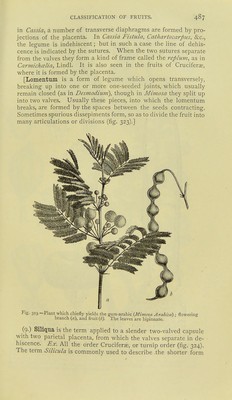
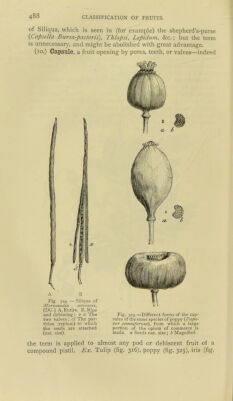
![in Cassia, a number of transverse diaphragms are formed by pro- jections of the placenta. In Cassia Fisttila, Cathartocarpiis, &c., the legume is indehiscent; but in such a case the line of dehis- cence is indicated by the sutures. When the two sutures separate from the valves they form a kind of frame called the replum, as in Carmichcelia, Lindl. It is also seen in the fruits of Cruciferas, where it is formed by the placenta. [Lomentum is a form of legume which opens transversely, breaking up into one or more one-seeded joints, which usually remain closed (as in Desmodiuin), though in Mimosa they split up into two valves. Usually these pieces, into which the lomentum breaks, are formed by the spaces between the seeds contracting. Sometimes spurious dissepiments form, so as to divide the fruit into many articulations or divisions (fig. 323).] Fig. 323.—Plant which chiefly yields the snm-a.rah\c {Mimosa Arabica) ; flowering branch (a), and fruit (i). The leaves are bipinnate. (9.) Siliqua is the term applied to a slender two-valved capsule with two parietal placenta, from which the valves separate in de- hiscence. Ex. All the order Crucifer?e, or turnip order (fig. 324). The term Silicula is commonly used to describe ,the shorter form](https://iiif.wellcomecollection.org/image/b21931902_0509.jp2/full/800%2C/0/default.jpg)
 No text description is available for this image
 No text description is available for this image
 No text description is available for this image