War against tropical disease : being seven sanitary sermons addressed to all interested in tropical hygiene and administration / by Andrew Balfour.
- Andrew Balfour
- Date:
- 1921
Licence: Attribution 4.0 International (CC BY 4.0)
Credit: War against tropical disease : being seven sanitary sermons addressed to all interested in tropical hygiene and administration / by Andrew Balfour. Source: Wellcome Collection.
91/232 page 91
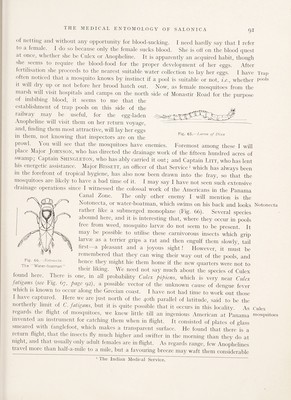
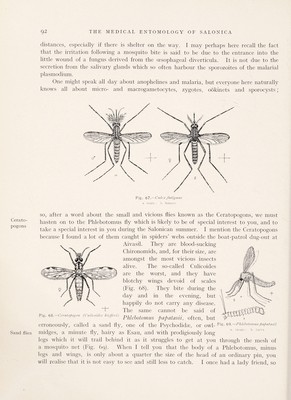
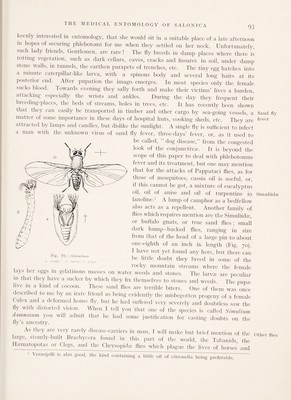
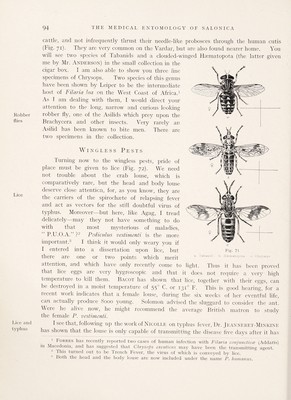
![Fig. 65.—Larva 0/ Dixa of netting and without any opportunity for blood-sucking. I need hardly say that I refer to a female. I do so because only the female sucks blood. She is off on the blood quest at once, whether she be Culex or Anopheline. It is apparently an acquired habit, though she seems to require the blood-food for the proper development of her eggs. After fertilisation she proceeds to the nearest suitable water collection to lay her eggs. I have Trap often noticed that a mosquito knows by instinct if a pool is suitable or not, i.e., whether Poo]s it will dry up or not before her brood hatch out. Now, as female mosquitoes from the marsh will visit hospitals and camps on the north side of Monastir Road for the purpose of imbibing blood, it seems to me that the establishment of trap pools on this side of the railway may be useful, for the egg-laden Anopheline will visit them on her return voyage, and, finding them most attractive, will lay her eggs in them, not knowing that inspectors are on the pi owl. You will see that the mosquitoes have enemies. Foremost among these I will place Major Johnson, who has directed the drainage work of the fifteen hundred acres of swamp; Captain Shingleton, who has ably carried it out; and Captain Litt, who has lent his energetic assistance. Major Bjssett, an officer of that Service 1 which has always been in the forefront of tropical hygiene, has also now been drawn into the fray, so that the mosquitoes are likely to have a bad time of it. I may say I have not seen such extensive drainage operations since I witnessed the colossal work of the Americans in the Panama Canal Zone. The only other enemy I will mention is the Notonecta, or water-boatman, which swims on his back and looks Notonecta rather like a submerged monoplane (Fig. 66). Several species abound here, and it is interesting that, where they occur in pools free from weed, mosquito larvae do not seem to be present. It may be possible to utilise these carnivorous insects which grip larvae as a terrier grips a rat and then engulf them slowly, tail first—a pleasant and a joyous sight ! However, it must be remembered that they can wing their way out of the pools, and hence they might hie them home if the new quarters were not to their liking. We need not say much about the species of Culex found heie. There is one, in all probability Culex pipiens, which is very near Culex fatigans (see Fig. 67, page 92), a possible vector of the unknown cause of dengue fever which is known to occur along the Grecian coast. I have not had time to work out those I have captured. Here we are just north of the 40th parallel of latitude, said to be the northerly limit of C. fatigans, but it is quite possible that it occurs in this locality. As Culex regards the flight of mosquitoes, we knew little till an ingenious American at Panama invented an instrument for catching them when in flight. It consisted of plates of glass smeared with tanglefoot, which makes a transparent surface. He found that there is a icturn flight, that the insects fly much higher and swifter in the morning than they do at night, and that usually only adult females are inflight. As regards range, few Anophelines tiavel mote than half-a-mile to a mile, but a favouring breeze may waft them considerable Fig-. 66.—Notonecta The “Water-boatman mosquitoes 1 the Indian Medical Service.](https://iiif.wellcomecollection.org/image/b29811752_0093.jp2/full/800%2C/0/default.jpg)