Manual of mental and physical tests : a book of directions compiled with special reference to the experimental study of school children in the laboratory or classroom / by Guy Montrose Whipple.
- Guy Montrose Whipple
- Date:
- 1910
Licence: In copyright
Credit: Manual of mental and physical tests : a book of directions compiled with special reference to the experimental study of school children in the laboratory or classroom / by Guy Montrose Whipple. Source: Wellcome Collection.
370/566 page 344
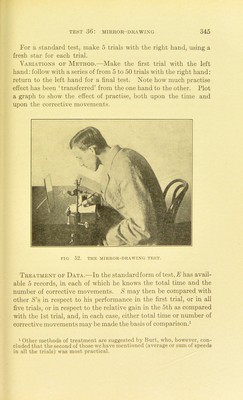
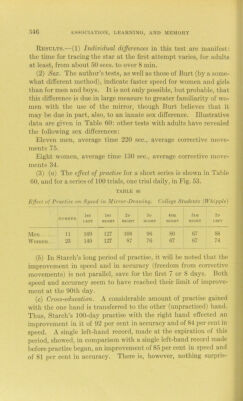
![Apparatus.—A 6-pointed star, printed in red ink.1 Mirror. Cardboard about 17 x 24 cm. [For the subsidiary tests, a 20 deg. prism.] Preliminaries.—Pin the star out flat upon a table, directly in front of' S, with the small cross-line that indicates the starting- point at the back, and the card square with the edge of the table. (This brings the star slightly 'out of true/ as is intended.) Set up the mirror, inclined slightly (about 5 deg.) from the vertical, just beyond the card. Arrange the screen (see Fig. 52) so that it will cut off S’s direct view of the star, but will allow him to see it clearly in the mirror, and will not interfere with his hand in drawing. Method.—Place the point of a lead pencil upon the cross-line of the star, and assist S to grasp the pencil (permitting him to look only in the mirror). Instruct “Trace the outline of the star, starting in this direction [indicating, by pointing, the tip of the star at the right of the cross-line]. Work as rapidly as you can, but try to keep on the line. Don’t stop to figure out what you ought to do, but keep your pencil going in some direction, and keep its point on the paper all the time.” Start the watch, and record the time for the entire drawing. E may also note the time for each sixth of the pattern. But it is, perhaps, more desirable to supplement the total time by a record of the total number of corrective movements made by S. Since these movements are often rapid, and of short extent, it is neces- sary to use a mechanical, or other form of counter to obtain the record. Press the counter every time S moves toward the line.2 1 This star resembles the pattern devised by W. F. Dearborn, and described by Starch, but it has been modified by being made slightly larger, printed in red ink, and tipped somewhat away from the vertical position, in order to avoid the too-easily drawn vertical lines. The author is experimenting with still another modification, viz: the use of double concentric stars, in the hope that this pattern may restrict the ex- tent of permissible excursion from the printed outline. With the single star, some S’a are inclined to slight their work, and so to reduce their time, while others try to keep exactly upon the line, with consequent extension of their time-records. Thus, one S, on his first trial, followed the tracing very poorly but completed his work in 46 sec.: on being asked to keep nearer the line, he consumed, on his second trial, 195 sec. 2 Every ‘error,’ or movement away from the line must, of course, be com- pensated for by a return movement. The idea is to register the number of these errors, or corrective movements. Changes of direction necessitated by the pattern itself are, obviously, to be neglected.](https://iiif.wellcomecollection.org/image/b28083179_0370.jp2/full/800%2C/0/default.jpg)
 No text description is available for this image
 No text description is available for this image
 No text description is available for this image