Manual of mental and physical tests : a book of directions compiled with special reference to the experimental study of school children in the laboratory or classroom / by Guy Montrose Whipple.
- Guy Montrose Whipple
- Date:
- 1910
Licence: In copyright
Credit: Manual of mental and physical tests : a book of directions compiled with special reference to the experimental study of school children in the laboratory or classroom / by Guy Montrose Whipple. Source: Wellcome Collection.
394/566 page 368
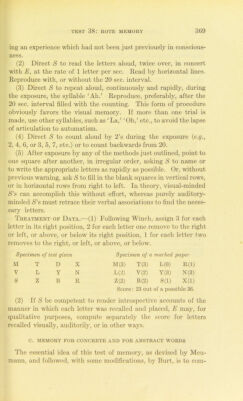
![as the correct one. The other, or duplicated, term should be regarded as an omission, and treated by the formula just given. Thus, in Case C, the total deviation = 6+3.3 = 9.3. (d) Suppose that more than the correct number of terms are reproduced: here the superfluous numbers may be ignored, since, save in exceptional cases, they bring about their own penalty by disturbing the correspondence of order. B. THE METHOD OF LETTER SQUARES The idea of displaying simultaneously a series of consonants in a simple spatial pattern appears first to have been suggested by Binet and Henri (8): the method was extended by Cohn (14), who used it to compare the relative values, for a given S, of visual and of auditory-motor learning; and it has since been frequently used as a method of studying ideational type.1 Winch used the letter square to contrast immediate with delayed reproduction, and in general to study the relation of memory to age, sex, and school standing, Smith (44) to compare the effect of various forms of distraction. Materials.—A set of 10 printed test-cards. Prepared forms upon which the reproduction is entered. Stop-watch. [The letter- square cards are printed in large type to make the test available for group procedure. The arrangement avoids the use of collo- cations that might serve as aids to memory. Only consonants are used. The blank forms are ruled in 12 squares.] Method.—Explain to S the general nature of the test. Inform him of the duration of exposure, but give him no directions as to how he shall attempt to learn the arrangement of the letters. . Expose the stimulus card for 25 sec. Let him fill out the blank form immediately after the exposure. Allow 20 sec. for writing. Repeat with other cards, until 4 to 10 trials have been made. Variations of Method.—(1) Defer the reproduction for 20 sec. (or 10 sec., to follow Cohn) after the exposure. Direct S to count aloud during this interval, from 1 to 20, 1 number per sec., in time with E (who may follow a silent metronome swinging once per sec.). The object is to subdue or eliminate the ‘memory after-image,’ and to secure true recall—in the strict sense of recall- 1 See, for instance, the modifications introduced for this purpose, in the Cornell laboratory, as described by Titchener (47, pp. 396 ff.).](https://iiif.wellcomecollection.org/image/b28083179_0394.jp2/full/800%2C/0/default.jpg)
 No text description is available for this image
 No text description is available for this image
 No text description is available for this image