Manual of mental and physical tests : a book of directions compiled with special reference to the experimental study of school children in the laboratory or classroom / by Guy Montrose Whipple.
- Guy Montrose Whipple
- Date:
- 1910
Licence: In copyright
Credit: Manual of mental and physical tests : a book of directions compiled with special reference to the experimental study of school children in the laboratory or classroom / by Guy Montrose Whipple. Source: Wellcome Collection.
405/566 page 379
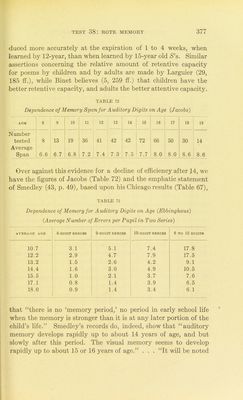
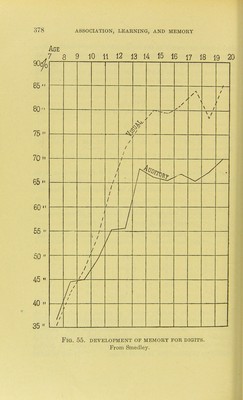
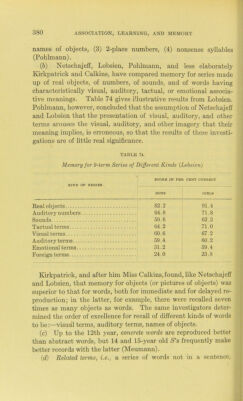
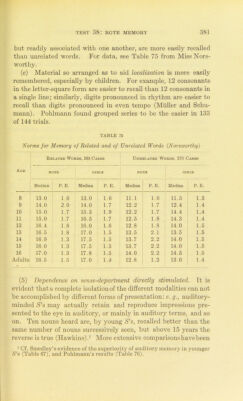
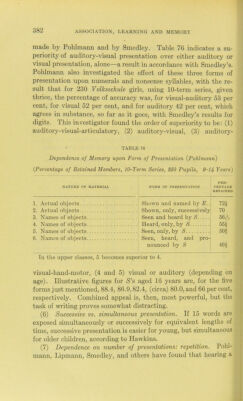
![[ Fig. 55] that, in the early life of the child, the auditory memory is stronger than the visual memory; after about 9 years of age, the visual memory of most of the children becomes stronger than the auditory memory, and continues to develop more rapidly than the auditory memory throughout school life. Yet, even in the high school, there still remains a small proportion of the pupils whose hearing memory is the stronger.” The dependence of different types of memory upon age has been studied especially by Netschajeff and by Lobsien. They agree substantially that, while the various forms of memory improve with age on the whole, there are periods of rapid development, followed by no impro\ement or even by a reduction; that while, on the whole, the greatest improvement occurs during the years 10 to 12, and development is retarded after 14, yet the different forms of memory, considered specifically, develop at different rates, and at periods that may not coincide in the two sexes. Thus, in boys, memory for objects is at first best developed, then follow, in order of chronological development, memory for visual terms, for acoustic terms, for actual sounds, for tactual terms, for numbers, for abstract terms, and finally for emotional terms. For girls, the chronological order is: visual terms, objects, sounds, numbers, abstract terms, acoustic terms, tactual terms, emotional terms. Special stress is laid upon the parallelism of development between memory for numbers and memory for abstract terms. In Meumann’s word-list tests, those types of error that indicate poor intelligence decreased with age, until, at 14 and 15, instances of misunderstood abstract terms were limited to about 10 per cent of his S’s, while meaningless fusions, meaningless insertions, and the substitution of concrete for abstract terms had nearly dis- appeared, and the memory for abstract terms had so increased as frequently to be superior to that for concrete terms. It follows that age must always be taken into account in the interpretation of this test, particularly in estimating intelligence by it. (4) Dependence on the nature of the material, (a) When digits and consonants are given under the same conditions, digits are easier to reproduce (Jacobs, Sharp), especially during the years 8 to 13 (Bourdon). But, if 10-place series are presented auditorily, thrice, the order of excellence for recall is (1) consonants, (2)](https://iiif.wellcomecollection.org/image/b28083179_0405.jp2/full/800%2C/0/default.jpg)