Manual of mental and physical tests : a book of directions compiled with special reference to the experimental study of school children in the laboratory or classroom / by Guy Montrose Whipple.
- Guy Montrose Whipple
- Date:
- 1910
Licence: In copyright
Credit: Manual of mental and physical tests : a book of directions compiled with special reference to the experimental study of school children in the laboratory or classroom / by Guy Montrose Whipple. Source: Wellcome Collection.
414/566 page 388
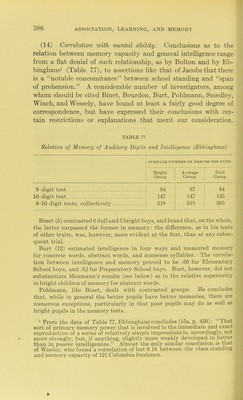
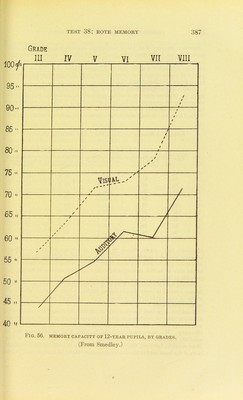
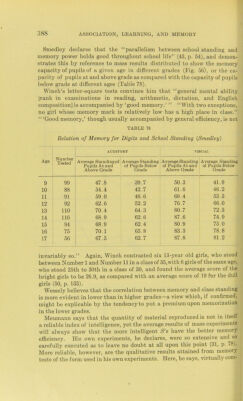
![Smedley declares that the “parallelism between school standing and memory power holds good throughout school life” (43, p. 54), and demon- strates this by reference to mass results distributed to show the memory capacity of pupils of a given age in different grades (Fig. 56), or the ca- pacity of pupils at and above grade as compared with the capacity of pupils below grade at different ages (Table 78). Winch’s letter-square tests convince him that “general mental ability [rank in examinations in reading, arithmetic, dictation, and English composition] is accompanied by ‘good memory.’ ” “With two exceptions, no girl whose memory mark is relatively low has a high place in class.” “ ‘Good memory,’ though usually accompanied by general efficiency, is not TABLE 78 Relation of Memory for Digits and School Standing (Smedley) Age Number Tested AUDITORY VISUAL Average Standing of Pupils At and Above Grade Average Standing of Pupils Below Grade Average Standing of Pupils At and Above Grade Average Standing of Pupils Below Grade 9 99 47.8 39.7 50.3 41.9 10 88 54.4 42.7 61.6 46.2 11 91 59.0 48.6 69.4 53.3 12 92 62.6 52.2 76.7 66.0 13 110 70.4 64.3 80.7 72.3 14 116 68.9 62.6 87.6 74.9 15 94 68.9 62.4 80.9 75.0 16 75 70.1 65.8 83.3 78.8 17 56 67.5 62.7 87.8 81.2 invariably so.” Again, Winch contrasted six 13-year old girls, who stood between Number 1 and Number 11 in a class of 35,with 6 girls of the same age, who stood 25th to 30th in a class of 30, and found the average score of the bright girls to be 26.9, as compared with an average score of 19 for the dull girls (50, p. 133). Wessely believes that the correlation between memory and class standing is more evident in lower than in higher grades—a view which, if confirmed, might be explicable by the tendency to put a premium upon memorization in the lower grades. Meumann says that the quantity of material reproduced is not in itself a reliable index of intelligence, yet the average results of mass experiments will always show that the more intelligent S’s have the better memory efficiency. His own experiments, he declares, were so extensive and so carefully executed as to leave no doubt at all upon this point (31, p. 78). More reliable, however, are the qualitative results attained from memory tests of the form used in his own experiments. Here, he says, virtually com-](https://iiif.wellcomecollection.org/image/b28083179_0414.jp2/full/800%2C/0/default.jpg)