Manual of mental and physical tests : a book of directions compiled with special reference to the experimental study of school children in the laboratory or classroom / by Guy Montrose Whipple.
- Guy Montrose Whipple
- Date:
- 1910
Licence: In copyright
Credit: Manual of mental and physical tests : a book of directions compiled with special reference to the experimental study of school children in the laboratory or classroom / by Guy Montrose Whipple. Source: Wellcome Collection.
415/566 page 389
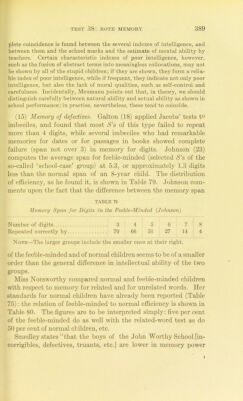
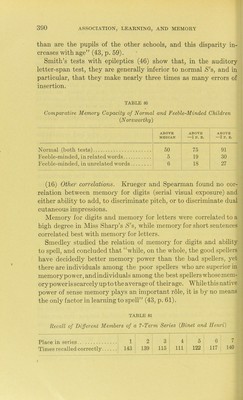
![plete coincidence is found between the several indexes of intelligence, and between them and the school marks and the estimate of mental ability by teachers. Certain characteristic indexes of poor intelligence, however, such as the fusion of abstract terms into meaningless collocations, may not be shown by all of the stupid children; if they are shown, they form a relia- ble index of poor intelligence, while if frequent, they indicate not only poor intelligence, but also the lack of moral qualities, such as self-control and carefulness. Incidentally, Meumann points out that, in theory, we should distinguish carefully between natural ability and actual ability as shown in school performance; in practise, nevertheless, these tend to coincide. (15) Memory of defectives. Galton (18) applied Jacobs’ tests to imbeciles, and found that most S’s of this type failed to repeat more than 4 digits, while several imbeciles who had remarkable memories for dates or for passages in books showed complete failure (span not over 3) in memory for digits. Johnson (23) computes the average span for feeble-minded (selected S’s of the so-called 'school-case’ group) at 5.3, or approximately 1.3 digits less than the normal span of an 8-year child. The distribution of efficiency, as he found it, is shown in Table 79. Johnson com- ments upon the fact that the difference between the memory span TABLE 79 Memory Span for Digits in the Feeble-Minded (Johnson) Number of digits 3 4 5 6 7 8 Repeated correctly by 70 66 51 27 14 4 Note—The larger groups include the smaller ones at their right. of the feeble-minded and of normal children seems to be of a smaller order than the general difference in intellectual ability of the two groups. Miss Norsworthy compared normal and feeble-minded children with respect to memory for related and for unrelated words. Her standards for normal children have already been reported (Table 75): the relation of feeble-minded to normal efficiency is shown in Table 80. The figures are to be interpreted simply: five per cent of the feeble-minded do as well with the related-word test as do 50 per cent of normal children, etc. Smedley states “that the boys of the John Worthy School [in- corrigibles, defectives, truants, etc.] are lower in memory power i](https://iiif.wellcomecollection.org/image/b28083179_0415.jp2/full/800%2C/0/default.jpg)