Thoughts on vaccination, and the cause of its failing to afford the same protection against variola, as formerly / by John M'Ghie.
- McGhie, John, active 1733
- Date:
- 1827
Licence: Public Domain Mark
Credit: Thoughts on vaccination, and the cause of its failing to afford the same protection against variola, as formerly / by John M'Ghie. Source: Wellcome Collection.
Provider: This material has been provided by London School of Hygiene & Tropical Medicine Library & Archives Service. The original may be consulted at London School of Hygiene & Tropical Medicine Library & Archives Service.
74/82 page 8
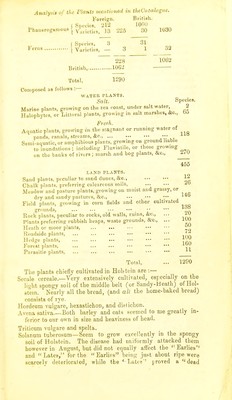
![meadows l)Ounded by quickset hedges, or by fences, made of intertwisted bouglis, reminded us of Kent, Surrey, and Sussei. The natural appearance of tlie country is also like the Sautli of Englimd, being diversified by numeions lulls and valleys, adorned with tlourishing woods and fertile fields. And for my own part, had it nut been for the German language, aiul some of the more primitive customs and costumes, I migl.t constantly have supposed myself botanizing in England, surrounded, as 1 was, by all the features of an English landscape. In some of the Frisian Islands, {e.g., Amrnm, which lies geographically nearest to England), many words are almost the same as our own. Take, for inslauce, the irregular verbs. Think, thought, are in Frisian theenk, thought ; bring, brought, are brhvj, broaght The English, How many miles ? strongly resembles, in sound at least, its Amrura analogue, Hu mani milel The simi:arity has actually given rise to a proverb — Butter, bread, and green cheese | ' Buwter, bread in greenelzics Is good English and good Fritse. ] Is guth Inglish iu guth i'l iesch.' The similarity between the two languages is, however, more striking to the ear than to the eye. From the catalogue I have here made of the Flora of Holsiein, I find that out of a total of 1290 species, no less than 1062, or cou.paratively nearly the whole, are British, and this ot course corroborates still more the resemblance already traced. And yet this country is corapara- ratively unknown to and unheeded by British touri ts and naturalists. Certain parts only of the continent seem to be the favourite scene of an Englishman's run, particularly Switzerland and the Rhine, while other localities as interesting and as lovely, are passed unnoticed. Holstein, moreover, is of very ea.sy access from Leith, London, or Hull; but though numbers of our countrymen annually visit Hamburg, it is only en route to Berlin or Vienna. . . j But to return from a very wide digression. JMy Head- quarters were situated in the most sterile of the four great belts already spoken of, viz, the Sand-Heaths; but within a circle of ten or fifteen miles, I had types of all the chief forma- tions of Holstein. Round Pinneberg and Rissen there are large patches of the Boulder Sand ; round Altona, at Schenefeld and Blankenese, the Boulder Chiy is characteristically exhibited ; at Blankenese and Schulau occur small patches of the Brown Coal. and on the Banks of the Elbe, beginning at Wedel, and attainingg a breadth of ten miles, occur the celebrated marshes, already so often mentioned. With this considerable variety of soil, 1 found a corresponding variety of the plants growing on it. The banks of the Elbe, between Altona and Wedel, a distance of twelve or fifteen miles, consist of a ridge of gravel hills (of the Boulder Sand formation) risnig abruptly from the river, and these, when covered with wood, have a very picturesque effect; so much so, that the fishing hamlet of BInnkenese re , inded me strongly of some of the most romoutic villages on the Rhine. The highest points of this ridge are dii;nified by the name of Height*](https://iiif.wellcomecollection.org/image/b21361174_0074.jp2/full/800%2C/0/default.jpg)