Thoughts on vaccination, and the cause of its failing to afford the same protection against variola, as formerly / by John M'Ghie.
- McGhie, John, active 1733
- Date:
- 1827
Licence: Public Domain Mark
Credit: Thoughts on vaccination, and the cause of its failing to afford the same protection against variola, as formerly / by John M'Ghie. Source: Wellcome Collection.
Provider: This material has been provided by London School of Hygiene & Tropical Medicine Library & Archives Service. The original may be consulted at London School of Hygiene & Tropical Medicine Library & Archives Service.
76/82 page 10
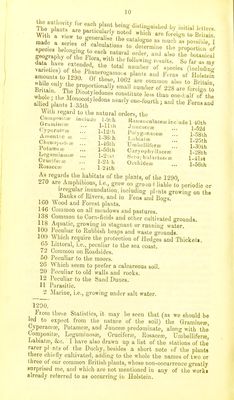
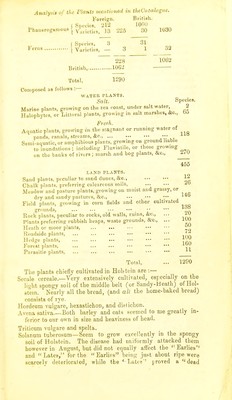
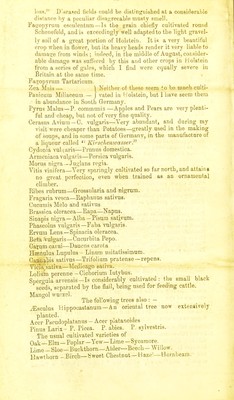
![while niilv thnT \ n' ''^ common also to Britain Brilain Vl e C'^r' «^ ^28 are /breign to Sd^',£rts'l°S''''° '.earl, one-lburtb; and the Ferns and With regacJ to the natural orders, the G3;::;r ''^'-^-/S Ra.,u.,ou,ace.incudel40th (^y;.orac.,o ... 1.12,h P,)lyg„naceffi 1 58tl, Amenuc.e ... 1.36:h ].,bi!„e {igh Chen,.,„„i,a^ ... l-iGth U.nbelliferte 1.30th Potaau,e ... l-oGth Carv„phvllacere l-ogth Leg..n„„os,e ... 1.2.st «oro; nulariacuu l-Ilst Crude, ,0 ... 1.2-i h 0.chide» ... Lssth Rosaccii; .. l-2ith As regards the habitats of the plants, of the 1290 270 are Amphibious, i e., groiv on gro„a i liable to periodic or irregular innundation, including phnts growing on the Banks of Rivers, and in Peas and Bon-s IGO Wood and Forest plants. ° 146 Common on all meadows and pastures. 138 Common to Corn-fields and other cultivated grounds. 118 Aqualic, growing in stagnant or running water. 100 Peculiar to Eubbish heaps and waste grounds. 100 Which require the protection of Hedges and Thieketi. 65 Littoral, i.e., peculiar to the sea coast. 72 Common on Roadsides. 50 Peculiar to the moors. 26 Which seem to prefer a calcareous soil. 20 Peculiar to old walls and rocks. 12 Peculiar to the Sand Dunes. 11 Parasitic. 2 Marine, i.e., growing under salt water. 1200. From theie Statistics, it may be seen that (as we should be led to expect from the iiatuie of the soil) the Gramineaj, Cvperaceaj, Potamcas, and Junceas predominate, along with the Composita?, Leguminosa3, Cruciferre, Rosacea;, Umbelliferte, Labiata;, &o. I have also drawn up a list of the stations of the rarer pi nts of the Diichy, besides a short note of the plants there chiefly cultivated, adding- to the whole the names of two or three of our common British plants, whose non-occurrence greatly surprised me, and which are not mentioned in any of the works already referred to as occurring in Holstein.](https://iiif.wellcomecollection.org/image/b21361174_0076.jp2/full/800%2C/0/default.jpg)