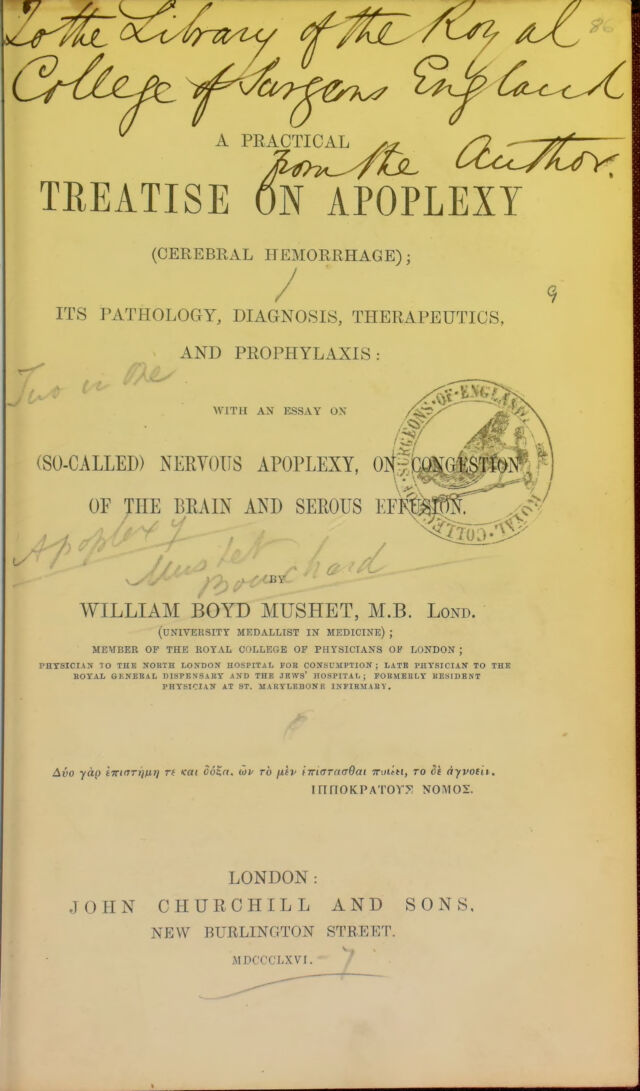
A practical treatise on apoplexy (cerebral hemorrhage), its pathology, diagnosis, therapeutics, and prophylaxis : with an essay on (so-called) nervous apoplexy, on congestion of the brain and serous effusion / by William Boyd Mushet.
- Boyd-Mushet, William.
- Date:
- 1866
Licence: Public Domain Mark
Credit: A practical treatise on apoplexy (cerebral hemorrhage), its pathology, diagnosis, therapeutics, and prophylaxis : with an essay on (so-called) nervous apoplexy, on congestion of the brain and serous effusion / by William Boyd Mushet. Source: Wellcome Collection.
Provider: This material has been provided by The Royal College of Surgeons of England. The original may be consulted at The Royal College of Surgeons of England.
196/200 page 192
![that there is no anatomical evidence that the brain is the origin of the coma. The attack is not to be im- puted to an intangible, inconceivable neurosis, but rather to disease of other organs, which should be careful]}- investigated, and, if necessary, analyzed. As to congestion and effusion, they are often present without antecedent symptoms of brain affection, and often absent after profound and protracted coma. Many hold that congestion tends to disappear after death, as Hope, Bennett, and Burrows, whilst Dr. Copland, on the contrary, thinks congestion partakes much of the nature of post-mortem changes. The appearance of congestion seems to be much regulated by the mode of death, properties and stasis of the blood, and many causes not satisfactorily settled. It is certain that symptoms almost identical may, in one instance, be observed with congestion; in another, witli effusion; in another, with normal appearance of the brain—a weighty token that these appearances are accidental and extraneous. The vascular condition of the brain varies much during sleep and wakefulness, during rest and exertion, and during intellectual repose and labour. Mr. Durham ( Guy's Hospital Reports, 1860) has demonstrated in opposition to Dr. Cappie ( Essays on Medical Sci- ence, 1859), that venous pressure is not the cause of sleep. On the contrary, there is diminished quantity and velocity of blood in the brain. Serous effusion, in senile and infantile hydrocephalus, may persist without interfering with consciousness. By most reflective men it is regarded as the result, frequently post-mortem, of other operations and not directly connected or associated with coma, as it may](https://iiif.wellcomecollection.org/image/b22302694_0198.jp2/full/800%2C/0/default.jpg)


 No text description is available for this image
 No text description is available for this image
 No text description is available for this image