A classical dictionary of Greek and Roman biography, mythology and geography / based on the larger dictionaries by Sir William Smith ; revised throughout and in part rewritten by G.E. Marindin.
- Date:
- 1899
Licence: Public Domain Mark
Credit: A classical dictionary of Greek and Roman biography, mythology and geography / based on the larger dictionaries by Sir William Smith ; revised throughout and in part rewritten by G.E. Marindin. Source: Wellcome Collection.
13/1036
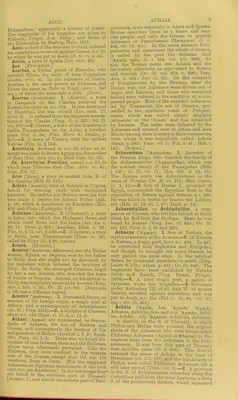
![blOGEAPHICAL, MYTHOLOGICAL, AND GEOGKAPHICAL ABA Aba. [Abus.] Abacaenum ('A$aKaivou or to 'k^aKawa: 'AficLKaivlvos: nr. Tripi, Ru.), a town of the Siculiin Sicily, about 4 miles from tlie N. coast, between Tyndaris and Mylae. The Coin of Abaoaennm In Sicily. boar and aconi Obr., head of Zeus; rt'L'., boar and acorn, on the coins of Abacaeniun refer to the forest of oaks covering the neighbouring mountains and affording pas- tm-e to herds of swine (Diod. xix. 65, 110). Abae ('AjSai: 'ABaTos: nr. Exarcho, Eu.), a town in the N.W. of Phocis, said to have been founded by the Argive Abas. [Abas, Abantes.] It possessed a temple and oracle of Ajiollo (Soph. Oed. T. 899), hence surnamed Abacus. The temple was destroyed in the invasion of Xei-xes, and a second time in the sacred war : it was rebuilt by Hadrian (Hdt. i. 46, viii. 27, 33, 134 ; Paus. x. 35). Abalus, said by Pytheas to be an island in the northern ocean, where amber was found, probably a portion of the Prussian coast upon the Baltic (Plin. xxxvii. § 35 ; Diod. v. 23). Abantes (A^avres), the ancient inhabitants of Euboea (Horn. II. ii. 536), hence called ^6«n- tis and Ahantias (Eur. Here. Fur. 185; Plin. iv. § 64). Hence Abantius, Euhoean (Stat. 8. iv. 8, 46). The Abantes are said to have first settled in Phocis, where they built Abae, and afterwards to have crossed over to Euboea. The Abantes of Euboea assisted in colonising several Ionic cities of Asia Minor (Hdt. i. 146). Abantiades, Abantias. lAbas.] Abantidas ('A.3afTi'5aj), murdered Clinias, the father of Aratus, and became tyrant of Sicyon. B.c. 264 (Plut. Arat. 2; Paus. ii. 8, 2). Abaris, idis, acc. Abarim ('A/3apij, i5os). 1. A Hv-perborean priest of Apollo who came to Greece, while his own country was visited by a plague, about b.c. 570. His history is mythical: he is said to have taken no earthly food, and to have ridden on his arrow, the gift of Apollo, through the air. He cured diseases by incantations, and delivered the world from a plague. Oracles and charms under his name ABDERA imssed current in later times (Hdt. iv. 36; mat. Charm, p. 158; Paus. iii. 13, 2).—2. Or Avaris, the fortified camp of the Hykscs during their occupation of Egypt, on the E. of the Pe- lusiac branch of the Nile (Joseph, c. Apion. i. 14). Hence Abaritanus (Plin. xvi. 172). Abaruis C A ^apv t s or A fiapvos : 'A0apvevs), a tovm near Lomi^sacus on the Asiatic side of the Hellespont (Xen. Hell. ii. 1, 29). Abas, antis (''A/Sas, avros), twelfth king of Argos, son of Lynceus, grandson of Danaus, and father of Acrisius. When he informed his father of the death of Danaus, he was rewarded with the shield of his grandfather, which was sacred to Hera. This shield performed various marvels. It was gained by Aeneas ('magni gestamen Abantis,' Verg. Aen. iii. 286). Abas is described as a successful conqueror and the founder of Abae in Phocis. [Abae.] Hence (i.) Abanteus, adj. (Ov. M. xv. 164). (ii.) Aban- tiades ('A;8oi'Tia5?)s), a descendant of Abas ; his son Acrisius (Ov. M. iv. 607), his great-grandson Perseus, by Danae, daughter of Acrisius (Ov. M. iv. 673, Am. iii. 12, 24). (iii.) Abantias, adis {'A^avTids, dSos), a female descendant of Abas, i.e. Danae. [Danae.] Abates, i, /. (A/SoToj, i.e. inaccessible), a rocky island in the Nile, near Philae (Sen. Q. N. iv. 2, 7; Luc. x. 323). Abbassus, a tovni of Phrygia (Liv. xxxviii. 15). Abdera (to A^Sripa, Abdera, ae. f., and Abdera, orum, n.: 'A^S7)p(T7)S, Abderites and Colli of Abdera In Thrace. Oiip., a grlffln. as symbol o( Apollo s worBhip; ' Calllda. nas. as tho maclBtrato of the year : rev., Afiinoinod. sur. rounding a square. Abderita, ae, vi.). 1, A to^vii of Thrace, near the mouth of the Nestus. According to mytho- B](https://iiif.wellcomecollection.org/image/b2178050x_0013.jp2/full/800%2C/0/default.jpg)




 No text description is available for this image
 No text description is available for this image
 No text description is available for this image