A text-book of physiological chemistry for students of medicine / by John H. Long.
- John Harper Long
- Date:
- 1909
Licence: Public Domain Mark
Credit: A text-book of physiological chemistry for students of medicine / by John H. Long. Source: Wellcome Collection.
Provider: This material has been provided by the Augustus C. Long Health Sciences Library at Columbia University and Columbia University Libraries/Information Services, through the Medical Heritage Library. The original may be consulted at the the Augustus C. Long Health Sciences Library at Columbia University and Columbia University.
31/416 page 19
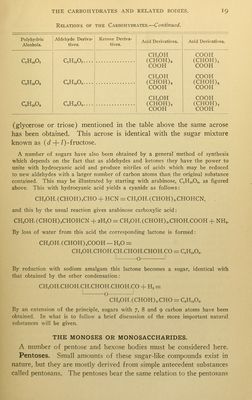
![Relations of the Carbohydrates.—Continued. Polyhydric Aldehyde Deriva- Ketone Deriva- Alcohols. tives. tives. C7H160T CSH1S0S CoHonOo C7H140T. Acid Derivatives. ^s-n-i6^'s ^d-^-is^'9 CH-OH (CHOH), COOH CHoOH (CHOH), COOH CH.OH (CHOH), COOH Acid Derivatives. COOH (CHOH)5 COOH COOH (CHOH)8 COOH COOH (CHOH)r COOH (glycerose or triose) mentioned in the table above the same acrose has been obtained. This acrose is identical with the sugar mixture known as (d -f- /)-fructose. A number of sugars have also been obtained by a general method of synthesis which depends on the fact that as aldehydes and ketones they have the power to unite with hydrocyanic acid and produce nitriles of acids which may be reduced to new aldehydes with a larger number of carbon atoms than the original substance contained. This may be illustrated by starting with arabinose, C5Hi0O5, as figured above. This with hydrocyanic acid yields a cyanide as follows: CH2OH.(CHOH)3CHO + HCN = CH2OH.(CHOH)3.CHOHCN, . and this by the usual reaction gives arabinose carboxylic acid: CH2OH.(CHOH)3CHOHCN + 2H20 = CH2OH.(CHOH)3.CHOH.COOH + NH,. By loss of water from this acid the corresponding lactone is formed: CH2OH.(CHOH)4COOH —H20 = CH,OH.CHOH.CH.CHOH.CHOHCO = C0H10Oc. -0- By reduction with sodium amalgam this lactone becomes a sugar, identical with that obtained by the other condensation: CH.OH.CHOH.CH.CHOH.CHOH.CO + H, = o ! CH2OH.(CHOH)4.CHO = QH]2O0. By an extension of the principle, sugars with 7, 8 and 9 carbon atoms have been obtained. In what is to follow a brief discussion of the more important natural substances will be given. THE MONOSES OR MONOSACCHARIDES. A number of pentose and hexose bodies must be considered here. Pentoses. Small amounts of these sugar-like compounds exist in nature, but they are mostly derived from simple antecedent substances called pentosans. The pentoses bear the same relation to the pentosans](https://iiif.wellcomecollection.org/image/b21214505_0031.jp2/full/800%2C/0/default.jpg)
 No text description is available for this image
 No text description is available for this image
 No text description is available for this image