A text-book of physiological chemistry for students of medicine / by John H. Long.
- John Harper Long
- Date:
- 1909
Licence: Public Domain Mark
Credit: A text-book of physiological chemistry for students of medicine / by John H. Long. Source: Wellcome Collection.
Provider: This material has been provided by the Augustus C. Long Health Sciences Library at Columbia University and Columbia University Libraries/Information Services, through the Medical Heritage Library. The original may be consulted at the the Augustus C. Long Health Sciences Library at Columbia University and Columbia University.
32/416 page 20
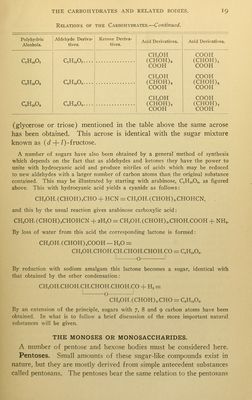
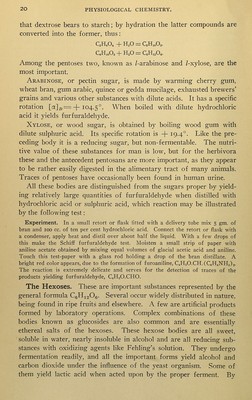
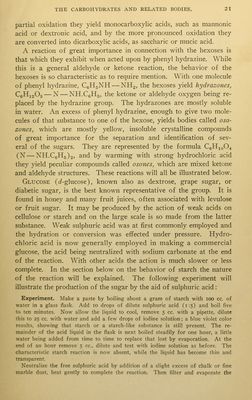
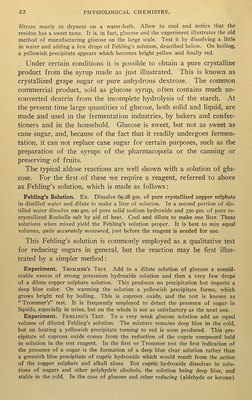
![that dextrose bears to starch; by hydration the latter compounds are converted into the former, thus: C5Hs04 + H20 = C5H10O5. C6H10O5 + H2Ot=C6H12O6. Among the pentoses two, known as /-arabinose and /-xylose, are the most important. Arabinose, or pectin sugar, is made by warming cherry gum, wheat bran, gum arabic, quince or gedda mucilage, exhausted brewers' grains and various other substances with dilute acids. It has a specific rotation [a]D= -f- 104.50. When boiled with dilute hydrochloric acid it yields furfuraldehyde. Xylose, or wood sugar, is obtained by boiling wood gum with dilute sulphuric acid. Its specific rotation is -f- 19.40. Like the pre- ceding body it is a reducing sugar, but non-fermentable. The nutri- tive value of these substances for man is low, but for the herbivora these and the antecedent pentosans are more important, as they appear to be rather easily digested in the alimentary tract of many animals. Traces of pentoses have occasionally been found in human urine. All these bodies are distinguished from the sugars proper by yield- ing relatively large quantities of furfuraldehyde when distilled with hydrochloric acid or sulphuric acid, which reaction may be illustrated by the following test: Experiment. In a small retort or flask fitted with a delivery tube mix 5 gm. of bran and 100 cc. of ten per cent hydrochloric acid. Connect the retort or flask with a condenser, apply heat and distil over about half the liquid. With a few drops of this make the Schiff furfuraldehyde test. Moisten a small strip of paper with aniline acetate obtained by mixing equal volumes of glacial acetic acid and aniline. Touch this test-paper with a glass rod holding a drop of the bran distillate. A bright red color appears, due to the formation of furoaniline, C4H3O.CH. (C6H4NH2)2. The reaction is extremely delicate and serves for the detection of traces of the products yielding furfuraldehyde, C4H3O.CHO. The Hexoses. These are important substances represented by the general formula C6H1206. Several occur widely distributed in nature, being found in ripe fruits and elsewhere. A few are artificial products formed by laboratory operations. Complex combinations of these bodies known as glucosides are also common and are essentially ethereal salts of the hexoses. These hexose bodies are all sweet, soluble in water, nearly insoluble in alcohol and are all reducing sub- stances with oxidizing agents like Fehling's solution. They undergo fermentation readily, and all the important forms yield alcohol and carbon dioxide under the influence of the yeast organism. Some of them yield lactic acid when acted upon by the proper ferment. By](https://iiif.wellcomecollection.org/image/b21214505_0032.jp2/full/800%2C/0/default.jpg)
 No text description is available for this image
 No text description is available for this image
 No text description is available for this image