A text-book of physiological chemistry for students of medicine / by John H. Long.
- John Harper Long
- Date:
- 1909
Licence: Public Domain Mark
Credit: A text-book of physiological chemistry for students of medicine / by John H. Long. Source: Wellcome Collection.
Provider: This material has been provided by the Augustus C. Long Health Sciences Library at Columbia University and Columbia University Libraries/Information Services, through the Medical Heritage Library. The original may be consulted at the the Augustus C. Long Health Sciences Library at Columbia University and Columbia University.
35/416 page 23
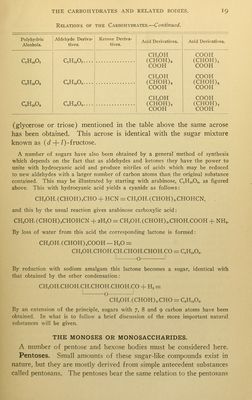
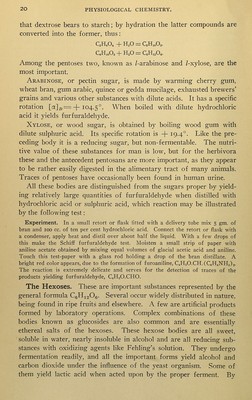
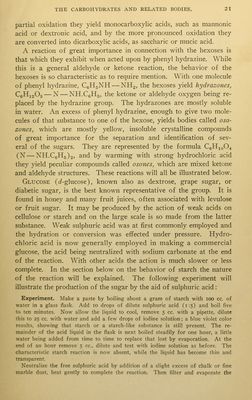
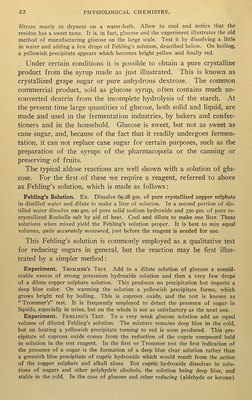
![sugars this stability is only temporary, since reduction follows on boiling. If the polyhydric alcohol employed to produce the deep blue solution is not a reducing substance the liquid remains clear and stable, even on boiling. This is the case with the Fehling's solution, in which the cupric hydroxide is held dissolved through the alcoholic behavior of the Rochelle salt. Similar solutions are made by the aid of glycerol (trihydric) and mannitol (hexahydric). The Fehling test has this ad- vantage over the Trommer test, that in the latter if too much copper sulphate is used, and little sugar is present the precipitate on boiling may be mainly black cupric oxide instead of the red cuprous oxide. With the Fehling liquid no black precipitate can form. Experiment. Bismuth Reduction Test. Add to a glucose solution some strong potassium hydroxide solution and then a very small amount of bismuth subnitrate. For an ordinary test a few milligrams will be enough. On boiling, a black pre- cipitate appears, which frequently forms a bright mirror on the walls of the test- tube. This precipitate seems to be a mixture of metallic bismuth with some oxide, and shows the strong reducing power of the sugar. Similar reductions may be obtained from alkaline solutions of several heavy metals, but these tests illustrate the general principle. Another test which serves for the recognition of even minute traces of glucose and other sugars, is the following, proposed by Molisch: Experiment. To a small amount of a dilute sugar solution add two drops of a solution of a-naphthol, containing about 20 gm. in 100 cc. On shaking the liquid becomes turbid. Now add to it an equal, or slightly greater, volume of pure strong sulphuric acid and shake. A deep violet color appears, which gives place to a violet precipitate on addition of water. This reaction has been shown to be due to the combination of the a-naphthol with furfuraldehyde produced by the action of sulphuric acid on the sugar present. Experiment. Phenyl Hydrazine Test. A characteristic reaction of great prac- tical value, referred to above, is given on the addition of phenyl hydrazine to a solution of glucose under certain definite conditions. To 20 cc. of a dilute glucose solution add about a gram of phenyl hydrazine hydrochloride, and two grams of sodium acetate. Heat on the water-bath half an hour, and then allow the liquid to cool. There will now be found a beautiful yellow crystalline precipitate of phenyl glucosazone, the nature of which is best- seen under the microscope. This test is one of great delicacy, and has been applied to the detection of traces of sugar in urine. But care must be taken to keep the reagent in considerable excess, since otherwise the soluble hydrazone may be formed. The melting point of the pure osazone is 205° C. The following reactions illustrate the combination of the phenyl hydrazine: C,HuO. + C6HB.NH.NH2 = C.HuO^N.NH.C.H. + H20, C.HuO. + 2C,H8NH.NH2 = C6H]0O4.(N.NH.QHB)2 + 2H20 + H2, Phenyl glucosazone C.H..NH.NH, + H2 = CeH8NH2 + NH3. By treatment with strong hydrochloric acid the osazone decomposes to yield an osone and phenyl hydrazine hydrochloride: CH1.04.(N.NH.C,H,)I + 2HCI + 2H20 = 2C.H5.NH.NH2.HC1 + CH20H.(CH0H)8.C0.CH0. Glucosone](https://iiif.wellcomecollection.org/image/b21214505_0035.jp2/full/800%2C/0/default.jpg)
 No text description is available for this image
 No text description is available for this image
 No text description is available for this image