A text-book of physiological chemistry for students of medicine / by John H. Long.
- John Harper Long
- Date:
- 1909
Licence: Public Domain Mark
Credit: A text-book of physiological chemistry for students of medicine / by John H. Long. Source: Wellcome Collection.
Provider: This material has been provided by the Augustus C. Long Health Sciences Library at Columbia University and Columbia University Libraries/Information Services, through the Medical Heritage Library. The original may be consulted at the the Augustus C. Long Health Sciences Library at Columbia University and Columbia University.
43/416 page 31
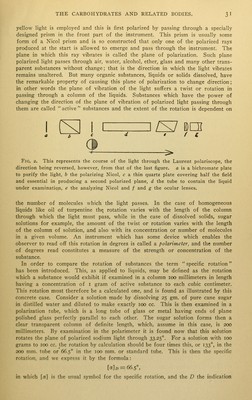
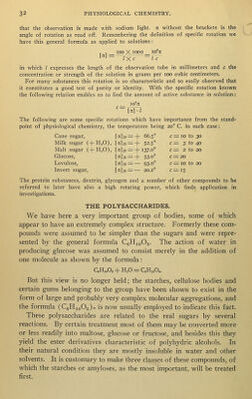
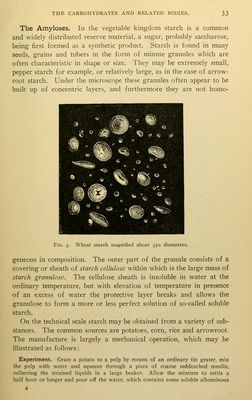
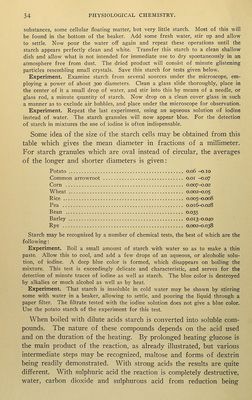
![yellow light is employed and this is first polarized by passing through a specially designed prism in the front part of the instrument. This prism is usually some form of a Nicol prism and is so constructed that only one of the polarized rays produced at the start is allowed to emerge and pass through the instrument. The plane in which this ray vibrates is called the plane of polarization. Such plane polarized light passes through air, water, alcohol, ether, glass and many other trans- parent substances without change; that is the direction in which the light vibrates remains unaltered. But many organic substances, liquids or solids dissolved, have the remarkable property of causing this plane of polarization to change direction; in other words the plane of vibration of the light suffers a twist or rotation in passing through a column of the liquids. Substances which have the power of changing the direction of the plane of vibration of polarized light passing through them are called active substances and the extent of the rotation is dependent on GO ■* ^ Fig. 2. This represents the course of the light through the Laurent polariscope, the direction being reversed, however, from that of the last figure. a is a bichromate plate to purify the light, b the polarizing Nicol, c a thin quartz plate covering half the field and essential in producing a second polarized plane, d the tube to contain the liquid under examination, e the analyzing Nicol and / and g the ocular lenses. the number of molecules which the light passes. In the case of homogeneous liquids like oil of turpentine the rotation varies with the length of the column through which the light must pass, while in the case of dissolved solids, sugar solutions for example, the amount of the twist or rotation varies with the length of the column of solution, and also with its concentration or number of molecules in a given volume. An instrument which has some device which enables the observer to read off this rotation in degrees is called a polarimeter, and the number of degrees read constitutes a measure of the strength or concentration of the substance. In order to compare the rotation of substances the term specific rotation has been introduced. This, as applied to liquids, may be defined as the rotation which a substance would exhibit if examined in a column ioo millimeters in length having a concentration of i gram of active substance to each cubic centimeter. This rotation must therefore be a calculated one, and is found as illustrated by this concrete case. Consider a solution made by dissolving 25 gm. of pure cane sugar in distilled water and diluted to make exactly 100 cc. This is then examined in a polarization tube, which is a long tube of glass or metal having ends of plane polished glass perfectly parallel to each other. The sugar solution forms then a clear transparent column of definite length, which, assume in this case, is 200 millimeters. By examination in the polarimeter it is found now that this solution rotates the plane of polarized sodium light through 33.250. For a solution with 100 grams to 100 cc. the rotation by calculation should be four times this, or 1330, in the 200 mm. tube or 66.50 in the 100 mm. or standard tube. This is then the specific rotation, and we express it by the formula: [a] D = 66.5°, in which [a] is the usual symbol for the specific rotation, and the D the indication](https://iiif.wellcomecollection.org/image/b21214505_0043.jp2/full/800%2C/0/default.jpg)
 No text description is available for this image
 No text description is available for this image
 No text description is available for this image