Second report from the Select Committee of the House of Lords on Metropolitan Hospitals, &c. : together with the Proceedings of the Committee, minutes of evidence, and appendix / Ordered, by the House of Commons, to be printed, 5 August 1891.
- House of Lords
- Date:
- 1891
Licence: Public Domain Mark
Credit: Second report from the Select Committee of the House of Lords on Metropolitan Hospitals, &c. : together with the Proceedings of the Committee, minutes of evidence, and appendix / Ordered, by the House of Commons, to be printed, 5 August 1891. Source: Wellcome Collection.
Provider: This material has been provided by Royal College of Physicians, London. The original may be consulted at Royal College of Physicians, London.
22/956 (page 4)
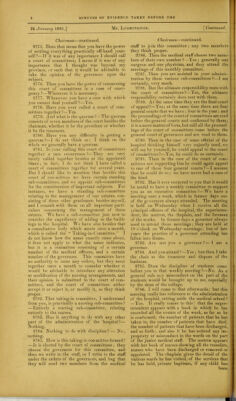
![26 January 1891.] Mr. Lushington. [ Continued. Chairman—continued. 9775. Does that mean that you have the power of settling everything practically off-hand your- self?—If it was of any importance I should call a court of committees; I mean if it was of any importance that I thought was beyond my province, or such that it would be advisable to take the opinion of the governors upon the subject. 9776. Then you have the power of summoning this court of committees in a case of emer- gency?—Whenever it is necessary. 9777. Whenever you have a case with which you cannot deal yourself?—Yes. 9778. Have you ever called a court of com- mittees together?—Yes. 97.79. And what is the quorum ?—The quorum consists of seven members of the court besides the chairman, whether it be the president or whether it be the treasurer. 9780. Have you any difficulty in getting a quorum ?—I do not think so ; I think on the whole we generally have a quorum. 9781. Is your calling this court of committees together a rare occurrence ?—They are very rarely called together besides at the appointed times; in fact, I do not think I have called a court of committees together for several years. But I should like to mention that besides this court of con mittces we have certain standing sub-committees, and we appoint sub-committees for the consideration of important subjects. For instance, we have a standing sub-committee relating to the management of our estates, con- sisting of three other gentlemen besides myself, and 1 consult with them on all important parti- culars concerning the management of these estates. We have a sub-committee just now to consider the exjiediency of adding to the build- ings in the hospital. We have also besides that a consultative body which meets once a month, which is called the “ Taking-in-Committee.” I do not know how the name exactly came about, it does not apply to v.’hat the name indicates, but it is a committee consisting of a certain number of the medical officers, and a certain number of the governors. This committee have no authority to issue any orders, but they meet together once a month to consider whether it would be advisable to introduce any alteration or modification of the nursing arrangements, and their opinion is submitted to the court of com- mittees, and the court of committees either accept it or reject it, or modify it, as they think proper. 9782. That taking-in committee, I understand from you, is practically a nursing sub-committee ? —Entirely a nursing sub-committee, relating entirely to the nurses. 9783. Has it anything to do with any other part of the administration of the hospital?— Nothing. 9784. Nothing to do with discipline? — No ; nothing. 9785. How is this taking-in committee formed? —It is elected by the court of committees ; they choose the governors for this committee, and then we write to the staff, or I write to the staff under the orders of the governors, and beg that they will send two members from the medical Chairman—continued. staff to join this committee ; any two members they think proper. 9786. Then the medical staff’choose two mem- | bers of their own number ?—Yes ; generally one j surgeon and one physician, and they attend the i meetings of this monthly committee. 9787. Then you are assisted in your adminis- | tration by these various sub-committees ?—1 am j certainly, very much. 9788. But the ultimate responsibility rests with the court of committees?—Yes, the ultimate ' responsibility certainly does rest with them. 9789. At the same time they are the final court of appeal?—Yes; at the same time there are four general courts that we have ; four in the year; and the proceedings of the court of committees are read before the general courts and confirmed by them; it is a mere matter of form, but still all the proceed • ! ings of the court of committees come before the j general court of governors and are read to them. 9790. Then in the case of some official of the | hospital thinking himself very unjustly used, we '• will say by yourself, he could appeal to the court of committees ?—Yes, he could do so certainly. 9791. Then in the case of the court of com- mittees not supporting him he could again appeal to one of these four general courts ?—I assume that he could do so ; we have never had a case of the kind. 9792. Has it ever occurred to you that it would be useful to have a weekly committee to support you as an executive committee ?—We have a meeting once a week, which in former days one j of the governors always attended. The meeting is held on Wednesday when 1 receive all the principal officers of the hospital, the superinten- dent, the matron, the chaplain, and the foreman of the works. In former days a governor always u used to attend those meetings ; they are held at 10 o’clock on Wednesday mornings; but of late | years the practice of a governor attending has fallen into disuse. 9793. Are not you a governor?—1 am a governor. 9794. And you attend ?—Yes ; but then I take the chair as the treasurer and dispose of the j business. 9795. Doe6 the discipline of students come before you in that weekly meeting?—No. As a j general rule any misconduct on the part of the students would be brought up to me, especially by the dean of the college. 9796. I will come to that afterwards; but this J meeting really has reference to the administration of the hospital, setting aside the medical school ? —Yes. It really comes to this': that the super- i mtendent appears with a book in which he has recorded all the events of the week, as far as he j is concerned; the number of patients that he has | taken in, the number of patients that have died, | the number of patients that have been discharged, and so forth ; and also it he has noticed any im- propriety or misconduct in the wards on the part of the junior medical staff. The matron appears with her book of nurses showing all the transfers, nurses who have been discharged or removed or appointed. The chaplain gives the detail of the various wards he has visited, of the services that he has held, private baptisms, if any child has been](https://iiif.wellcomecollection.org/image/b28040156_0024.jp2/full/800%2C/0/default.jpg)