Second report from the Select Committee of the House of Lords on Metropolitan Hospitals, &c. : together with the Proceedings of the Committee, minutes of evidence, and appendix / Ordered, by the House of Commons, to be printed, 5 August 1891.
- House of Lords
- Date:
- 1891
Licence: Public Domain Mark
Credit: Second report from the Select Committee of the House of Lords on Metropolitan Hospitals, &c. : together with the Proceedings of the Committee, minutes of evidence, and appendix / Ordered, by the House of Commons, to be printed, 5 August 1891. Source: Wellcome Collection.
Provider: This material has been provided by Royal College of Physicians, London. The original may be consulted at Royal College of Physicians, London.
25/956 page 7
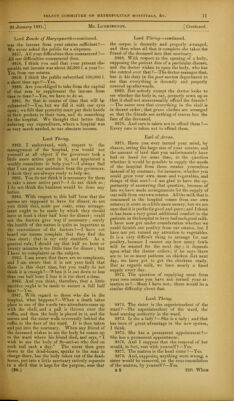
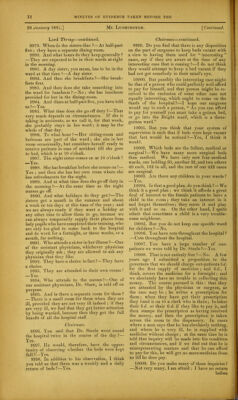
![Mr. Lushington. [ Continued. 26 January 1891.] Chairman—continued. he has nothing to do with the medical work of the hospital?—I think he ought not to be called me- dical superintendent at all ; that is a term that has crept in. When he was appointed in 1853 lie was appointed as steward, and resident superintendent I think was his title, and it had nothing to do with the medical department at all. 9849. He called himself medical superinten- dent, l think, when he was examined here ?— Yes, but he was never appointed so by the Court. Earl Catlicart. 9850. He is called “ superintendent ” in Bur- dett’s Hospital Annual ?—Yes, that is the title by which he generally goes. Chairman. 9851. In answer to Question 614 he gave us his exact position and title as “ medical superin- tendent ”?■—“ Medical ” is not correct, strictly speaking. 9852. Where do the resident officers, the house physicians, and house surgeons, live.?—Till within the last year, the last few months I may say, they lived in accommodation that was assigned to them in the hospital, and they were fed at the expense of the hospital; they had bed- rooms and meals provided for them at the expense of the hospital. When the college was built and opened, I think in April last or May last, they went over to the college, and we handed over to the college authorities the money; and pay them annually the money that they used to cost us when they boarded and lodged in the hospital. 9853. Is that the Residential College of Students ?—Y es 9854. Is that residential college some way from some of the wards?—It is immediately outside the gates, and we have a subway leading into the wards. 9855. Then you have actually no medical officer residing within the walls of the hospital? —Yes, we have in this way, that the medical officer on duty for the week, and the surgeon on duty for the week, sleep in the hospital, but they do not get their meals in it. 9856. So that those are the gentlemen who are called down in case of an accident being brought in in the middle of the night.?—Yes, or in a case of any serious illness occurring suddenly. 9857. Have those gentlemen salaries ?—They have no salaries. 9858. Now, as regards the nurses, you began to tell us something about the sisters; by whom are the sisters appointed ?—The sisters of the hospital are appointed by myself; that is to say, the matron informs me that a ward is vacant, and she recommends A. B . or C. D. to be the sister of the ward, and these sisters are generally taken from amongst the lady pupils who have been trained in the hospital, and who have had a year’s training ; so that they come to us knowing all about the hospital, and knowing their re- spective duties. 9859. Do you train your own nurses at the hospital?—Yes, we train our own nurses at the hospital. 9860. You appoint the nurses on the recom- mendation of the lady superintendent?—The sisters I appoint. (24.) Chairman—continued. 9861. They are commissioned, as it were, by you ?—Yes. 9862. But who appoints the nurses ?—The nurses come as probationers; all our nurses begin life as probationers; 9863. Who appoints them ?—They are ap- pointed by the matron. 9864. They are commissioned, one may say, by the matron ?—Yes; and provided they conduct themselves properly they become, after 18 months, full nurses. 9865. Being appointed by the matron, are they also dismissed by the matron?—During the period of their probation they are dismissed by the matron. 9866. Is that up to 18 months ?—That is up to 18 months. 9867. Then, at the same time, is the engage- ment terminable by the other party, the pro- bationer, during her time of probation?—Yes; for the first month they have the option of ter- minating their engagement if they think proper. After that, after the first month, they sign papers to say that they will serve us for three years. 9868. Then there is no giving a month’s notice, and going away ?—No. 9869. Then, do I understand that the matron has power to discharge ?—Yes, the probationers. 9870. As regards the full nurses, who dis- charges them ?—She would speak to Dr. Steele, the superintendent, on the subject, and if they were both of one mind I think the matron would probably speak to me first about it, and then discharge the woman ; but that very seldom, if ever, happens. 9871. But that seems rather a haphazard way of doing it; would it not be simpler if the matron had simply the power of suspending, and then bringing the thing formally before you ?—That would be, perhaps, a more complete way of doing the business ; but I think that, as I am always on the spot, there is scarcely any necessity for that. When I say always on the spot, I am on the spot every day for six months, and, during the rest of the year, always three days a week. There is scarcely any necessity for suspending a nurse pending such orders as I might have to give on the subject. 9872. The fact of your being on the spot, you mean, obviates the necessity for suspension ?— Yes. I think, if a nurse committed any very flagrant act, the matron would immediately re- move her out of the ward and apply to me for orders ; that would be practically suspension. 9873. But, as a matter of your own private opinion, do you think it wise to give a sub- ordinate official the power of dismissal ?—Yes; 1 have no doubt it is advisable to give the matron this power to dismiss probationers. Nobody can really so well tell as herself whether they are inefficient or incompetent. She visits all our wards every day, and she knows the work of everybody in the wards. 9874. Does the matron go round all the wards every day ?—Every day. 9875. Does the superintendent go round the wards ?—Lvery day. He goes round the wards every morning; he goes into the wards and ascertains the number of beds empty, or likely A 4 to](https://iiif.wellcomecollection.org/image/b28040156_0027.jp2/full/800%2C/0/default.jpg)
 No text description is available for this image
 No text description is available for this image
 No text description is available for this image