DNA-repair mechanisms : symposium, Schloss Reinhartshausen/Rhein, Oct. 4th/5th, 1971 / chairman H. Altmann.
- Date:
- [1972]
Licence: Attribution-NonCommercial 4.0 International (CC BY-NC 4.0)
Credit: DNA-repair mechanisms : symposium, Schloss Reinhartshausen/Rhein, Oct. 4th/5th, 1971 / chairman H. Altmann. Source: Wellcome Collection.
236/262 (page 224)
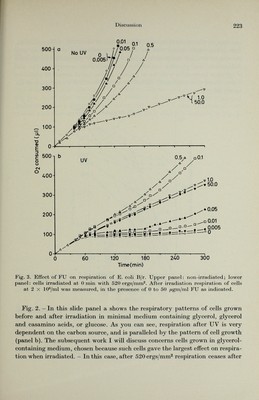
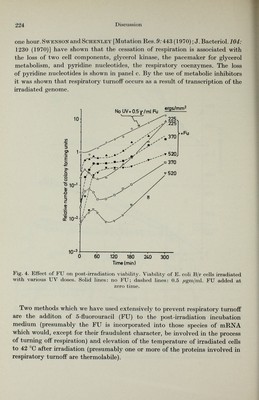
![one hour. Swenson and Schenley [Mutation Res. 9:443 (1970); J.Bacteriol.104: 1230 (1970)] have shown that the cessation of respiration is associated with the loss of two cell components, glycerol kinase, the pacemaker for glycerol metabolism, and pyridine nucleotides, the respiratory coenzymes. The loss of pyridine nucleotides is shown in panel c. By the use of metabolic inhibitors it was shown that respiratory turnoff occurs as a result of transcription of the irradiated genome. Time (min) Fig. 4. Effect of FU on post-irradiation viability. Viability of E. coli B/r cells irradiated with various UV doses. Solid lines: no FU ; dashed lines: 0.5 /¿gm/ml. FU added at zero time. Two methods which we have used extensively to prevent respiratory turnoff are the additon of 5-fluorouracil (FU) to the post-irradiation incubation medium (presumably the FU is incorporated into those species of mRNA which would, except for their fraudulent character, be involved in the process of turning off respiration) and elevation of the temperature of irradiated cells to 42 °C after irradiation (presumably one or more of the proteins involved in respiratory turnoff are thermolabile).](https://iiif.wellcomecollection.org/image/b18021232_0237.JP2/full/800%2C/0/default.jpg)