DNA-repair mechanisms : symposium, Schloss Reinhartshausen/Rhein, Oct. 4th/5th, 1971 / chairman H. Altmann.
- Date:
- [1972]
Licence: Attribution-NonCommercial 4.0 International (CC BY-NC 4.0)
Credit: DNA-repair mechanisms : symposium, Schloss Reinhartshausen/Rhein, Oct. 4th/5th, 1971 / chairman H. Altmann. Source: Wellcome Collection.
239/262 (page 227)
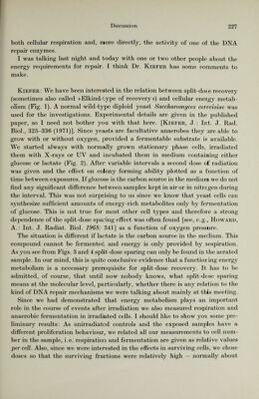
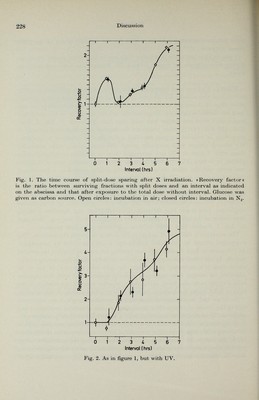
![both cellular respiration and, more directly, the activity of one of the DNA repair enzymes. I was talking last night and today with one or two other people about the energy requirements for repair. I think Dr. Kiefer has some comments to make. Kiefer : We have been interested in the relation between split-dose recovery (sometimes also called »Elkind-type of recovery«) and cellular energy metab olism (Fig. 1). A normal wild-type diploid yeast Saccharomyces cerevisiae was used for the investigations. Experimental details are given in the published paper, so I need not bother you with that here. [Kiefer, J.: Int. J. Rad. Biol., 325-336 (1971)]. Since yeasts are facultative anaerobes they are able to grow with or without oxygen, provided a fermentable substrate is available. We started always with normally grown stationary phase cells, irradiated them with X-rays or UV and incubated them in medium containing either glucose or lactate (Fig. 2). After variable intervals a second dose of radiation was given and the effect on colony forming ability plotted as a function of time between exposures. If glucose is the carbon source in the medium we do not find any significant difference between samples kept in air or in nitrogen during the interval. This was not surprising to us since we know that yeast cells can synthesize sufficient amounts of energy-rich metabolites only by fermentation of glucose. This is not true for most other cell types and therefore a strong dependence of the split-dose sparing effect was often found [see, e.g., Howard, A.: Int. J. Radiat. Biol. 1968: 341] as a function of oxygen pressure. The situation is different if lactate is the carbon source in the medium. This compound cannot be fermented and energy is only provided by respiration. As you see from Figs. 3 and 4 split-dose sparing can only be found in the aerated sample. In our mind, this is quite conclusive evidence that a functioning energy metabolism is a necessary prerequisite for split-dose recovery. It has to be admitted, of course, that until now nobody knows, what split-dose sparing means at the molecular level, particularly, whether there is any relation to the kind of DNA repair mechanisms we were talking about mainly at this meeting. Since we had demonstrated that energy metabolism plays an important role in the course of events after irradiation we also measured respiration and anaerobic fermentation in irradiated cells. I should like to show you some pre liminary results: As unirradiated controls and the exposed samples have a different proliferation behaviour, we related all our measurements to cell num ber in the sample, i.e. respiration and fermentation are given as relative values ;per cell. Also, since we were interested in the effects in surviving cells, we chose doses so that the surviving fractions were relatively high - normally about](https://iiif.wellcomecollection.org/image/b18021232_0240.JP2/full/800%2C/0/default.jpg)