DNA-repair mechanisms : symposium, Schloss Reinhartshausen/Rhein, Oct. 4th/5th, 1971 / chairman H. Altmann.
- Date:
- [1972]
Licence: Attribution-NonCommercial 4.0 International (CC BY-NC 4.0)
Credit: DNA-repair mechanisms : symposium, Schloss Reinhartshausen/Rhein, Oct. 4th/5th, 1971 / chairman H. Altmann. Source: Wellcome Collection.
256/262 (page 244)
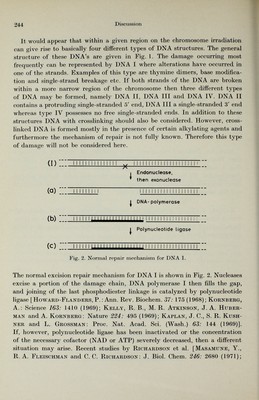
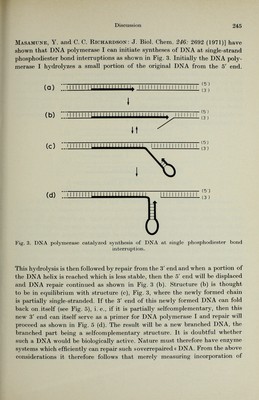
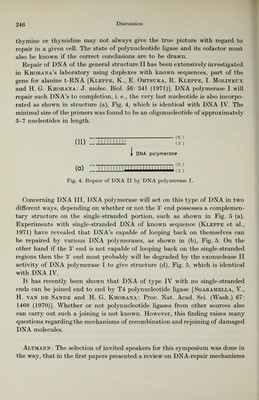
![It would appear that within a given region on the chromosome irradiation can give rise to basically four different types of DNA structures. The general structure of these DNA’s are given in Fig. 1. The damage occurring most frequently can be represented by DNA I where alterations have occurred in one of the strands. Examples of this type are thymine dimers, base modifica tion and single-strand breakage etc. If both strands of the DNA are broken within a more narrow region of the chromosome then three different types of DNA may be formed, namely DNA II, DNA III and DNA IV. DNA II contains a protruding single-stranded 5' end, DNA III a single-stranded 3' end whereas type IV possesses no free single-stranded ends. In addition to these structures DNA with crosslinking should also be considered. However, cross- linked DNA is formed mostly in the presence of certain alkylating agents and furthermore the mechanism of repair is not fully known. Therefore this type of damage will not be considered here. 1111111111 Mill v 1 II II II 1 1 II 1 1 1 II 1 1 II M A 1 Endonuclease, then exonuclease (a) MINIMI Il 1 II II II II II II II 1 II DNA- polymerase (b) | Polynucleotide ligase (C) Il II i 1 LL Il 1 1 1 1 1 1 II 1 II 1 1 1 II 1 II 1 1 II II II II II 1 Fig. 2. Normal repair mechanism for DNA I. The normal excision repair mechanism for DNA I is shown in Fig. 2. Nucleases excise a portion of the damage chain, DNA polymerase I then fills the gap, and joining of the last phosphodiester linkage is catalyzed by polynucleotide ligase [Howard-Flanders, P. : Ann. Rev. Biochem. 37: 175 (1968) ; Kornberg, A.: Science 163: 1410 (1969); Kelly, R. B., M. R. Atkinson, J. A. Huber- man and A. Kornberg: Nature 224: 495 (1969); Kaplan, J. C., S. R. Kush- ner and L. Grossman: Proc. Nat. Acad. Sci. (Wash.) 63: 144 (1969)]. If, however, polynucleotide ligase has been inactivated or the concentration of the necessary cofactor (NAD or ATP) severely decreased, then a different situation may arise. Recent studies by Richardson et al. [Masamune, Y., R. A. Fleischman and C. C. Richardson: J. Biol. Chem. 246: 2680 (1971);](https://iiif.wellcomecollection.org/image/b18021232_0257.JP2/full/800%2C/0/default.jpg)