DNA-repair mechanisms : symposium, Schloss Reinhartshausen/Rhein, Oct. 4th/5th, 1971 / chairman H. Altmann.
- Date:
- [1972]
Licence: Attribution-NonCommercial 4.0 International (CC BY-NC 4.0)
Credit: DNA-repair mechanisms : symposium, Schloss Reinhartshausen/Rhein, Oct. 4th/5th, 1971 / chairman H. Altmann. Source: Wellcome Collection.
257/262 (page 245)
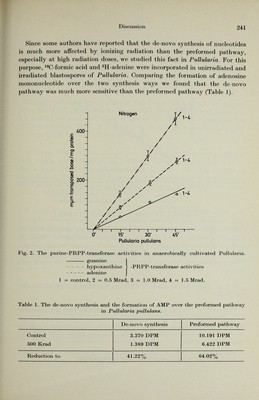
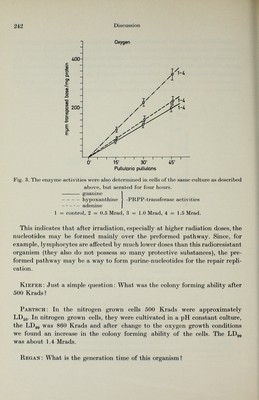
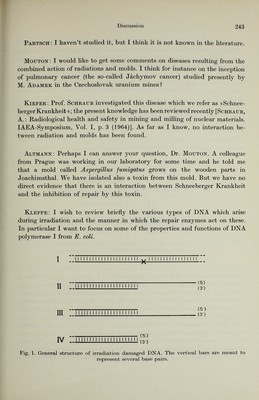
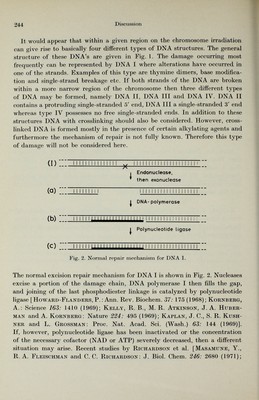
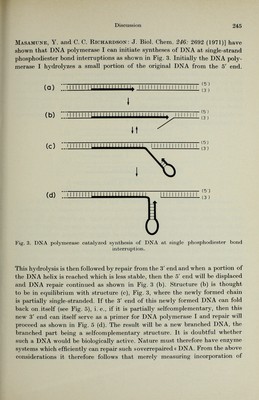
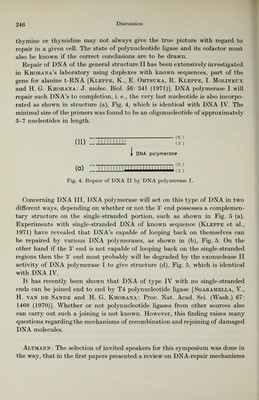
![Masamune, Y. and C. C. Richardson: J. Biol. Chem. 246: 2692 (1971)] have shown that DNA polymerase I can initiate syntheses of DNA at single-strand phosphodiester bond interruptions as shown in Fig. 3. Initially the DNA poly merase I hydrolyzes a small portion of the original DNA from the 5' end. ( a ) 11111111N 111111111111| 111111 ii 11111 ( 5 ) (3 ) I (b) ~ I I I I I I I I I ( 5 ) (3 ) It (c) (d) ( 5 ) (3 ) Fig. 3. DNA polymerase catalyzed synthesis of DNA at single phosphodiester bond interruption. This hydrolysis is then followed by repair from the 3' end and when a portion of the DNA helix is reached which is less stable, then the 5' end will be displaced and DNA repair continued as shown in Fig. 3 (b). Structure (b) is thought to be in equilibrium with structure (c), Fig. 3, where the newly formed chain is partially single-stranded. If the 3' end of this newly formed DNA can fold back on.itself (see Fig. 5), i. e., if it is partially selfcomplementary, then this new 3' end can itself serve as a primer for DNA polymerase I and repair will proceed as shown in Fig. 5 (d). The result will be a new branched DNA, the branched part being a selfcomplementary structure. It is doubtful whether such a DNA would be biologically active. Nature must therefore have enzyme systems which efficiently can repair such »overrepaired« DNA. From the above considerations it therefore follows that merely measuring incorporation of](https://iiif.wellcomecollection.org/image/b18021232_0258.JP2/full/800%2C/0/default.jpg)