Licence: Public Domain Mark
Credit: History of dentistry in Cleveland, Ohio. Source: Wellcome Collection.
Provider: This material has been provided by the University of Toronto, Harry A Abbott Dentistry Library, through the Medical Heritage Library. The original may be consulted at the Harry A Abbott Dentistry Library, University of Toronto.
25/204 page 21
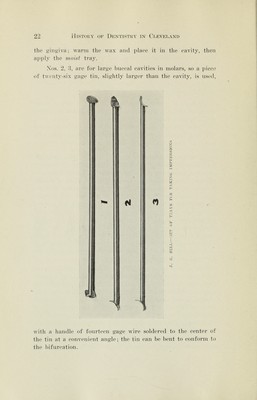
![the metal into a i)latinuiii matrix, wliidi had heen formed in a tootli cavity, by use of wooden sticks (no investment of matrix). In 1910 «iave the teehnic for makinu iidays ])y using Ney's non-colicsive liold foil for a matrix, and sweating into it twenty- two carat gold plate. lie devised a speeial ))ook for keeping the record of menibei's of dental societies. VwiSKY E. Barnes, Dent. Dept. W. R. IT., 1899. Demon- strator Prosthesis and Orthodontia, 1899-1901, and chief of these clinics in above Dept. AVhen Rec. Sec. Cleveland Dental Society, he introduced a new^ style of book in ^vhich the records were typewritten, with marginal references. Practice limited to Orthodontia. J. K. Bell was ])orn in Orange O., Feb. 1, 1858, his youth- ful days were passed on his father's farm, and his preliminary education acquired in the public schools, and Geauga Seminary; later he entered Hillsdale College, Hillsdale, ]\lich., earning his Avay hy teaching part of the time. He came here 1872 and studied dentistry with B. F. and J. E. Robinson, and attended the Cleveland ^Medical College during two sessions and received a certificate for anatomy, physiology, chemistry, materia med- ica and surgery; in 1876 graduated from Ohio Col. Dent. Sur., where he assisted in the clinics; then he came here and opened an office, and has been continuously in practice. In the HonKPopathie Hospital College, later Cleveland University of IMedicine and Surgery, he lectured for nine years on dental sur- gery and also ojierated in the infirmary. He devised trays for taking impressions in wax or dental ^ lac, when making gold or porcelain inlays, which are specially useful for labial, buccal or distal cavities extending undei' the gingivae. These trays are rights and lefts, but with slight changes are universal, No. 1 is for use on anterior teetli and is made viz.: a piece of twenty-six gage tin is cut large enough to cover the cavity, and after contouring it to conform with the tooth, take a piece of German silver wire twelve gauge, and file one end at an angle of forty-five degrees, and soft solder it to the center of the tin. Now the tray can be accurately adapted and polished so that the edge will pass under the free margin of](https://iiif.wellcomecollection.org/image/b2120326x_0025.jp2/full/800%2C/0/default.jpg)