Licence: Public Domain Mark
Credit: History of dentistry in Cleveland, Ohio. Source: Wellcome Collection.
Provider: This material has been provided by the University of Toronto, Harry A Abbott Dentistry Library, through the Medical Heritage Library. The original may be consulted at the Harry A Abbott Dentistry Library, University of Toronto.
29/204 page 25
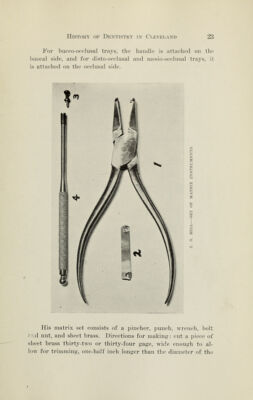
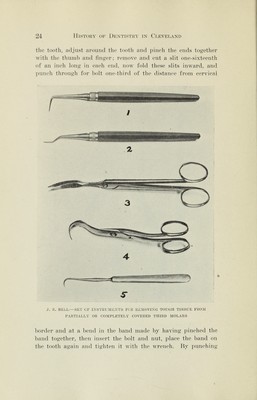
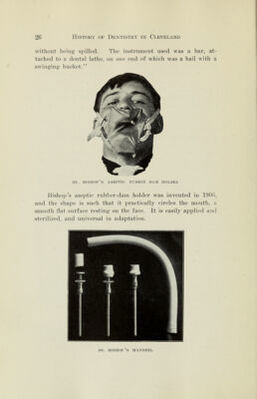
![the l)an(l as indicated four thicknesses liave been i)ierce(l, two on each end of tlie l)and, thus j)rovidint» for double tension at tlie cervical portion of the tooth. Fi.u-. 1 shows the puncli. l^y punchin»i- through the edjie of the folded band, one-half of the head and nut of the bolt—cervical side—will rest on extra thicknesses around the cervix -. place the nut beveled side first, then it will not sli]) when ti^ihtened. Fi*?. 2 shows band after folding, cutting- and punching. Fig. 3, bolt; Fig. 4, wi'cnch. After filling, unscrew and remove bolt and nut; straighten the band somewhat and remove it. If amalgam is used, let it be medium quick setting mixed stiff; thus avoiding amalgama- tion with the brass matrix. The matrix can be made slightly crescent-shaped, then by placing the concave portion at cervix, when the band is tightened it will bear on the cervical portion of the tooth first. lie also devised a set of four instruments for removing tough tissue from, partially or ccmipletely covered third molars. Fig. 1 is a lanc(^ with blade at right angles to the shaft, designed to sever the tissue by an incision between the second and third molar. Fig. 2 is bayonet-shaped with a blunt, smooth blade ^'orced into the incision made by Fig. 1, between the >^\ the imbedded tooth, thus raising the tissue. Fig. U with long blades and beaded points (universal), are forcing one blade into the opening made by Fig. 2 and ^lade along the ])uccal side; another cut is made in th(^ , only on the lingual side. Fig.4, scissors with circular d beaded points, used to make the fourth and final cut stal margin of imbedded tooth. Fig. 5, tenaculum foi* into the cut flap to hold and remove it when Fig. 4 i from the lingual side far enough buccally, so that ^*elip is made, a scpiare of tissue is removed. 895 when he was in Jerusalem he secured a gavel, made wood from the ]\lt. of Olives, which he presented to eland Dental Society. •]. Bishop says: On Dec. 6, 1907, I first used a bucket ng gold inlays by centrifugal force. The principle in- >eing, that whatever the size of the cast, the bucket would allow the mass of metal to take a lower plane J. ? h Lu 0 0 m > m oc < < X or m > !j DC J DC < < 1- I z LU Q hi I 1-](https://iiif.wellcomecollection.org/image/b2120326x_0029.jp2/full/800%2C/0/default.jpg)