Licence: Public Domain Mark
Credit: As a matter of course. Source: Wellcome Collection.
Provider: This material has been provided by the Harvey Cushing/John Hay Whitney Medical Library at Yale University, through the Medical Heritage Library. The original may be consulted at the Harvey Cushing/John Hay Whitney Medical Library at Yale University.
146/156
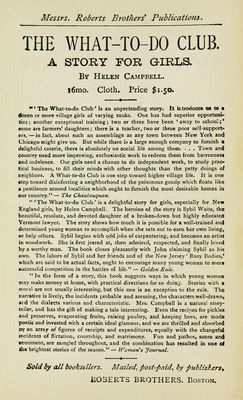
![THE WHAT-TO-DO CLUB. A STORY FOR GIRLS. By Helen Campbell. l6mo. Cloth. Price $1.50. *• • The What-to-do Club ■ is an unpretending story. It ittroducefl OS SO ft dozen or more village girls of varying ranks. One has had superior opportuni- ties; another exceptional training; two or three have been 'away to school;' come are farmers' daughters; there is a teacher, two or three poor self-support- ers, — in fact, about such an assemblage as any town between New York and Chicago might give us. But while there is a large enough company to furnish a delightful coterie, there is absolutely no social life among them. . . . Town and country need more improving, enthusiastic work to redeem them from barrenness and indolence. Our girls need a chance to do independent work, to study prac- tical business, to fill their minds with other thoughts than the petty doings oi neighbors. A What-to-do Club is one step toward higher village life. It is one step toward disinfecting a neighborhood of the poisonous gossip which floats like a pestilence around localities which ought to furnish the most desirable homes in our country. — The Chautauquan. *The What-to-do Club ' is a delightful story for girls, especially for New England girls, by Helen Campbell. The heroine of the story is Sybil Waite, tho beautiful, resolute, and devoted daughter of a broken-down but highly educated Vermont lawyer. The story shows how much it is possible for a well-trained and determined young woman to accomplish when she sets out to earn her own living, or help others. Sybil begins with odd jobs of carpentering, and becomes an artist in woodwork. She is first jeered at, then admired, respected, and finally loved by a worthy man. The book closes pleasantly with John claiming Sybil as his own. The labors of Sybil and her friends and of the New Jersey ' Busy Bodies,* which are said to be actual facts, ought to encourage many young women to mora successful competition in the battles of life. — Golden Rule. In the form of a story, this book suggests ways in which young women may make money at home, with practical directions for so doin^- Stories witli a moral are not usually interesting, but this one is an exception to the rule. The narrative is lively* the incidents probable and amusing, the characters wel]-drawn( and the dialects various and characteristic. Mrs. Campbell is a natural story- teller, and has the gift of making a tale interesting. Even the recipes for pickles and preserves, evaporating fruits, raising poultry, and keeping bees, are made poetic and invested with a certain ideal glamour, and we are thrilled and absorbed vy an array of figures of receipts and expenditures, equally with the changeful incidents of flirtation, courtship, and matrimony. Fun and pathos, sense and sentiment, are mingled throughout, and the combination has resulted in one of the brightest stories of the season. — Womaift JourtuU. Sold by all booksellers. Mailed, post-paid, by publishers^](https://iiif.wellcomecollection.org/image/b21031253_0146.jp2/full/800%2C/0/default.jpg)