Licence: Public Domain Mark
Credit: Some remarks on the Great Tope at Sânchi / by S. Beal. Source: Wellcome Collection.
Provider: This material has been provided by The Royal College of Surgeons of England. The original may be consulted at The Royal College of Surgeons of England.
4/24 page 2
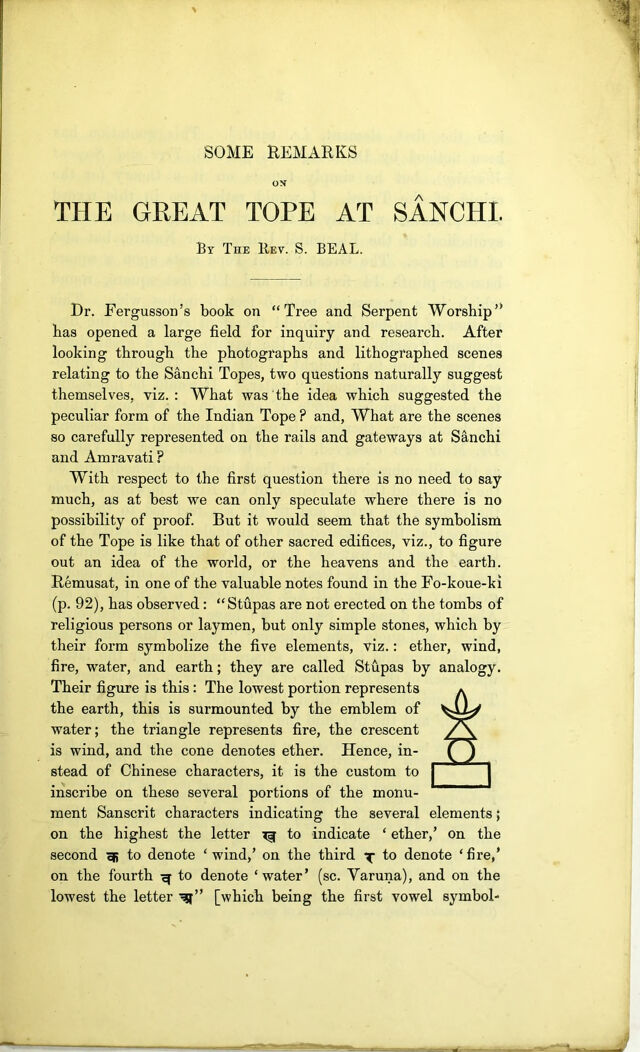
![izes tlie first element, i.e. earth]. This quotation has been noticed by Dr. Fergusson (p. 106, Tree and Serpent Worship), but he simply founds on it a theory for the origin of the Trisul. I would rather see in this record an explanation not only of the earliest religious structures,^ symbolical of the Elemental Universe or Nature, but also of the Tope. The Great Sanchi Tope rests upon a square base or plinth 14 feet high and 121 feet square, round which is a procession path 5 feet 6 inches wide. This portion of the building would therefore symbolize the first element, “ earth.” Above the square rises a great dome or hemisphere to a height of 39 feet. This dome repre- sents the second element, “ water.” It would be impossible to place a complete circle of stone on the square plinth, the hemisphere therefore is used to indicate the element. Dr. Muir has observed, that “when the idea of Varuna as the all-embracing Heaven had been established, and on the other hand the observation of the Rivers flowing towards the ends of the earth and to the sea had led to the con- jecture that there existed an Ocean inclosing the earth in its bosom, then the way was thoroughly prepared for connect- ing Varuna with the Ocean.” [Compare the entire account given by Dr. Muir, J.R.A.S. vol. i. part i. N.S. pp. 77, ss.] Above the dome, at Sanchi, we have a Toran, respecting which I will quote from Hodgson : “ Between the hemisphere and the pyramid is a short square basement for the latter, upon each of the four sides of which a pair of eyes is graved.^ The hemisphere is called the ‘ garbh,’ the basement the ‘ Toran,’ and the pyramid the ‘ Chura-mani’ (p. 43, Collected ' I refer to Logan stones, etc., hut principally to those primitive structures called “ Baitulia” or “Boetylia.” I take the rows of stones represented in m 206 of Sir J. Lubbock’s work “ On the Origin of Civilization, etc.,” to be Boetylia, or “ anointed stones”—the red mark round the black (which Colonel Forbes Leslie compares to “ spots of blood”) being in fact the “ marks of conse- cration” or “anointing.” It is well known that “idols” or “ josses” in China are consecrated by a dash of red or vermilion across the eye. With regard to the derivation of the word “Boetylia” as signifying “elemental stones,” whilst it is generally referred to a Semitic root, I venture to suggest -)- or as denoting that these stones in the first instance represented the “ Elemental World.” * These eyes evidently denote the watchful care of the “ Four Kings ” (Chaturmaharajahs) over the affairs of men.](https://iiif.wellcomecollection.org/image/b2239803x_0006.jp2/full/800%2C/0/default.jpg)