Licence: In copyright
Credit: Psychological principles / by James Ward. Source: Wellcome Collection.
35/504 page 15
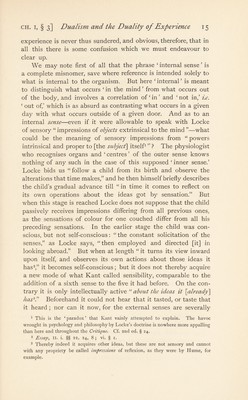
![experience is never thus sundered, and obvious, therefore, that in all this there is some confusion which we must endeavour to clear up. We may note first of all that the phrase ‘ internal sense ’ is a complete misnomer, save where reference is intended solely to what is internal to the organism. But here ‘ internal ’ is meant to distinguish what occurs ‘ in the mind 5 from what occurs out of the body, and involves a correlation of £ in ’ and ‘ not in,’ i.e. ‘ out of,’ which is as absurd as contrasting what occurs in a given day with what occurs outside of a given door. And as to an internal sense—even if it were allowable to speak with Locke of sensory “ impressions of objects extrinsical to the mind ”—what could be the meaning of sensory impressions from “ powers intrinsical and proper to [the subject] itself1 ” ? The physiologist who recognises organs and ‘ centres ’ of the outer sense knows nothing of any such in the case of this supposed ‘ inner sense.’ Locke bids us “ follow a child from its birth and observe the alterations that time makes,” and he then himself briefly describes the child’s gradual advance till “ in time it comes to reflect on its own operations about the ideas got by sensation.” But when this stage is reached Locke does not suppose that the child passively receives impressions differing from all previous ones, as the sensations of colour for one couched differ from all his preceding sensations. In the earlier stage the child was con¬ scious, but not self-conscious: “ the constant solicitation of the senses,” as Locke says, “ then employed and directed [it] in looking abroad.” But when at length “ it turns its view inward upon itself, and observes its own actions about those ideas it has2,” it becomes self-conscious; but it does not thereby acquire a new mode of what Kant called sensibility, comparable to the addition of a sixth sense to the five it had before. On the con¬ trary it is only intellectually active “ about the ideas it [already] has3.” Beforehand it could not hear that it tasted, or taste that it heard ; nor can it now, for the external senses are severally 1 This is the ‘ paradox ’ that Kant vainly attempted to explain. The havoc wrought in psychology and philosophy by Locke’s doctrine is nowhere more appalling than here and throughout the Critiqtie. Cf. 2nd ed. § 24. 2 Essay, II. i. §§ 22, 24, 8 ; vi. § 1. 3 Thereby indeed it acquires other ideas, but these are not sensory and cannot with any propriety be called impressions of reflexion, as they were by Hume, for example.](https://iiif.wellcomecollection.org/image/b29817304_0035.jp2/full/800%2C/0/default.jpg)



 No text description is available for this image
 No text description is available for this image
 No text description is available for this image