Certain aboriginal remains of the Black Warrior River : certain aboriginal remains of the lower Tombigbee River : certain aboriginal remains of Mobile Bay and Mississippi Sound : miscellaneous investigation in Florida / by Clarence B. Moore.
- Clarence Bloomfield Moore
- Date:
- 1905
Licence: Public Domain Mark
Credit: Certain aboriginal remains of the Black Warrior River : certain aboriginal remains of the lower Tombigbee River : certain aboriginal remains of Mobile Bay and Mississippi Sound : miscellaneous investigation in Florida / by Clarence B. Moore. Source: Wellcome Collection.
22/220 page 138
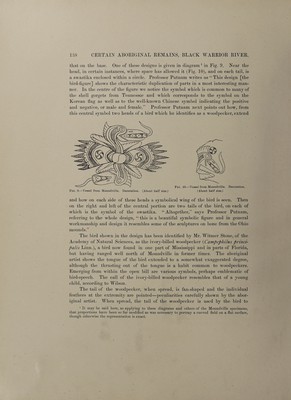
![that on the base. One of these designs is given in diagram 1 in Fig. 9. Near the head, in certain instances, where space has allowed it (Fig. 10), and on each tail, is a swastika enclosed within a circle. Professor Putnam writes us “ This design [the bird-figure] shows the characteristic duplication of parts in a most interesting man¬ ner. In the centre of the figure we notice the symbol which is common to many of the shell gorgets from Tennessee and which corresponds to the symbol on the Korean flag as well as to the well-known Chinese symbol indicating the positive and negative, or male and female.” Professor Putnam next points out how, from this central symbol two heads of a bird which he identifies as a woodpecker, extend and how on each side of these heads a symbolical wing of the bird is seen. Then on the right and left of the central portion are two tails of the bird, on each of .which is the symbol of the swastika. “ Altogether,” says Professor Putnam, referring to the whole design, “ this is a beautiful symbolic figure and in general workmanship and design it resembles some of the sculptures on bone from the Ohio mounds.” The bird shown in the design has been identified by Mr. Witmer Stone, of the Academy of Natural Sciences, as the ivory-billed woodpecker (Campcphilus princi¬ palis Linn.), a bird now found in one part of Mississippi and in parts of Florida, but having ranged well north of Moundville in former times. The aboriginal artist shows the tongue of the bird extended to a somewhat exaggerated degree, although the thrusting out of the tongue is a habit common to woodpeckers. Emerging from within the open bill are various symbols, perhaps emblematic of bird-speech. The call of the ivory-billed woodpecker resembles that of a young child, according to Wilson. The tail of the woodpecker, when spread, is fan-shaped and the individual feathers at the extremity are pointed—peculiarities carefully shown by the abor¬ iginal artist.. When spread, the tail of the woodpecker is used by the bird to 1 It may be said here, as applying to these diagrams and others of the Moundville specimens, that proportions have been so far modified as was necessary to portray a curved field on a flat surface, though otherwise the representation is exact.](https://iiif.wellcomecollection.org/image/b3135175x_0022.jp2/full/800%2C/0/default.jpg)

 No text description is available for this image
 No text description is available for this image
 No text description is available for this image