Chronic diseases of the larynx : with special reference to laryngoscopic diagnosis and local therapeutics / By Dr. Adelbert Tobold ... Tr. from the German and ed. by George M. Beard ... With an introduction on the history and art of laryngoscopy and rhinoscopy ... by the editor.
- Tobold, Adelbert, 1827-1907.
- Date:
- 1868
Licence: Public Domain Mark
Credit: Chronic diseases of the larynx : with special reference to laryngoscopic diagnosis and local therapeutics / By Dr. Adelbert Tobold ... Tr. from the German and ed. by George M. Beard ... With an introduction on the history and art of laryngoscopy and rhinoscopy ... by the editor. Source: Wellcome Collection.
Provider: This material has been provided by the Harvey Cushing/John Hay Whitney Medical Library at Yale University, through the Medical Heritage Library. The original may be consulted at the Harvey Cushing/John Hay Whitney Medical Library at Yale University.
267/312
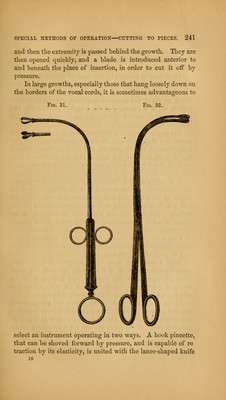
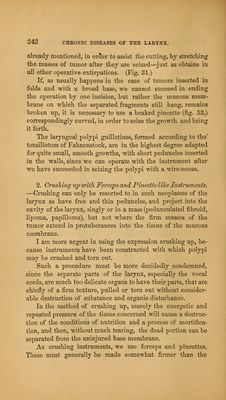
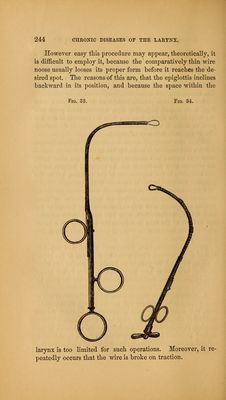
![above-mentioned laryngeal instruments, as they can develop a greater power. The forceps that I use is quite similar to an ordinary pharyngeal forceps, only the curve is correspondingly greater, the blades crossed and provided with extremities. The little spoons have sharp angles, and internally short tooth- like extremities. It is improper to provide such kind of instruments with long, hook-shaped, projecting tips, because these press into the mass of the tumor, interfere with the removal of the for- ceps, or make it very difficult, to say nothing of the destruc- tion of the parts that may be caused. When the laryngeal space is very narrow, these forceps, that are so unavoidably large, are not as suitable as an instru- ment that works like a pincette, although, on the other hand, the pressure with the former can be exercised independently and according to the requirement of the operator, but in the princette this must be left to the force of the spring. I have lately improved instruments that answer for the re- moval of masses of tumor. They are quite similar to those already mentioned, with this change only, that instead of the hook-shaped, beaked shank, with two spoon-shaped extremi- ties, the end of the tube that forms the covering has a some- what bulbous extremity, in order to give a larger hold to the beaked pincette. Both instruments are introduced closed, and are first opened at the moment when, under the guidance of the laryn- goscope, we reach the mass to be crushed to pieces. In with- drawing, it is well to take care that the blades do not easily open by the pressure that is used, thereby injuring the parts by tearing. 3. Extirpation!)]) a noose.—Since the introduction of laryn- goscopy, it has become very well known among all laryngolo- gists, that cases of polypi are comparatively frequent, for the removal of which (among the great mass of instruments recom- mended) such also are used that have special reference to the method practised by Roderick, which consists in surround- ing and cutting through the foreign growth with a noose of the modern 6crascur.](https://iiif.wellcomecollection.org/image/b21001017_0267.jp2/full/800%2C/0/default.jpg)