A treatise on the diseases of the ear including the anatomy and physiology of the organ together with the treatment of the affections of the nose and pharynx which conduce to aural disease.
- Hovell, Mark, 1853-1925
- Date:
- 1894
Licence: Public Domain Mark
Credit: A treatise on the diseases of the ear including the anatomy and physiology of the organ together with the treatment of the affections of the nose and pharynx which conduce to aural disease. Source: Wellcome Collection.
Provider: This material has been provided by the Harvey Cushing/John Hay Whitney Medical Library at Yale University, through the Medical Heritage Library. The original may be consulted at the Harvey Cushing/John Hay Whitney Medical Library at Yale University.
35/752
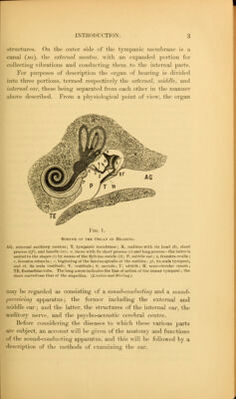
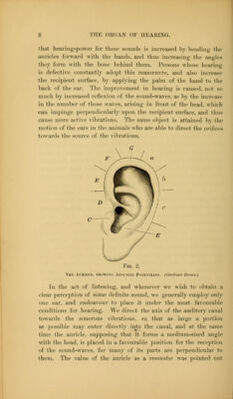
![adapted for the reception and transmission of sound-waves, some of wliich at the same time it reflects. Irrespective of its elevations and depressions, it forms a somewhat flattened plate, impulses against the surface of which are transmitted over it in every direction. Tliese impulses are most freely conducted when the sonorous waves impinge perpendicularly upon the auricle, and the nearer this direction is approached the more extensive will the vibrations become. But the auricle is not a level surface, and the whole of it can never be acted upon in a perpendicular direction by sonorous undulations proceeding from a given point. The importance of the complicated elevations and depressions on its surface thus becomes manifest; for undulations impinging upon the auricle from any direction must fall advantageously, i.e., perpendicularly or nearly so, upon some of them, and then be propagated without much loss of force. The most favourable position for the trans- mission of sound is when the ear is so situated that the plane of the largest portion of its surface is directed perpendicularly towards the source of the stimulus. It is very diflicult to estimate the amount of reflection which takes place from the auricle. Boerhave thought that this structure reflected all sound-waves impinging upon it, in such a manner that they were directed into the external meatus. Very careful experiments made with wax models of the ear have, however, shoNvn that no matter at what angle the sound-waves impinge upon the auricle, only a very few of them can possibly be directed to\N'ards the meatus, and that there are but few points on the surface from which a sound-wave can take this direction. It would likewise appear that the double reflection from the concha to the tragus takes place to a very limited extent, and that the value of the auricle as a reflector of waves of sound is quite inconsiderable. A deep concha is said to be accompanied by increase of hearing- ])Ower, and some authors have supposed that the size of the angle which the auricle makes with the surface of the mastoid process influences the capacity for perceiving sounds; an angle of 40° is said to be the most favourable, while hearing power is considerably diminished when the angle is less than 15°. A general statement of this kind must, however, be incorrect, for there is no one angle w hich can be suitable for all sound-^^'aves. The angle may, cer- tainh, be of considerable importance with reference to sonorous vibrations arising in front of the head ; we know by experience](https://iiif.wellcomecollection.org/image/b21019423_0035.jp2/full/800%2C/0/default.jpg)