A manual of practical hygiene / by Edmund A. Parkes.
- Edmund Alexander Parkes
- Date:
- 1887
Licence: Public Domain Mark
Credit: A manual of practical hygiene / by Edmund A. Parkes. Source: Wellcome Collection.
Provider: This material has been provided by the Augustus C. Long Health Sciences Library at Columbia University and Columbia University Libraries/Information Services, through the Medical Heritage Library. The original may be consulted at the the Augustus C. Long Health Sciences Library at Columbia University and Columbia University.
53/846 (page 27)
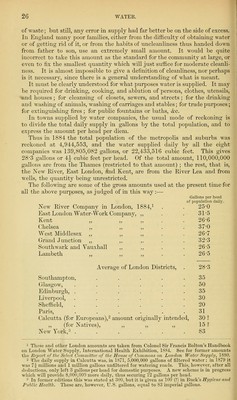
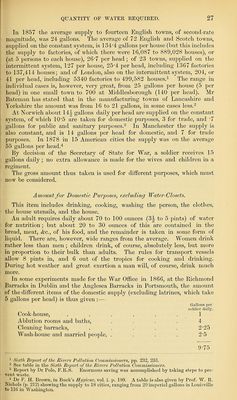
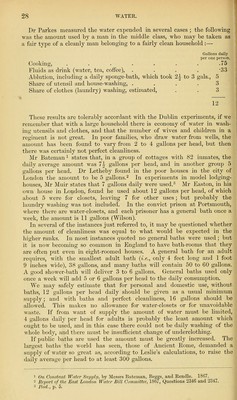
![In 1857 the average supply to fourteen English towns, of second-rate magnitude, was 24 gallons. The average of 72 English and Scotch towns, supphed on the constant system, is 1344 gallons per house (but this includes the supply to factories, of which there were 16,087 to 889,028 houses), or (at 5 persons to each house), 26-7 per head; of 23 towns, supplied on the intermittent system, 127 per house, 25*4 per head, including 1367 factories to 137,414 houses; and of London, also on the intermittent system, 204, or 41 per head, including 5340 factories to 499,582 houses.^ The range in individual cases is, however, very great, from 25 gallons per house (5 per head) in one small town to 700 at Middlesborough (140 per head). Mr Bateman has stated that in the manufacturing towns of Lancashire and Yorkshire the amount was from 16 to 21 gallons, in some cases less.^ At Norwich about 14J gallons daily per head are supplied on the constant system, of which 10'5 are taken for domestic purposes, 3 for trade, and 7 gallons for public and sanitary purposes.^ In Manchester the supply is also constant, and is 14 gallons per head for domestic, and 7 for trade purposes. In 1878 in 15 American cities the supply was on the average 55 gallons per head.^ By decision of the Secretary of State for War, a soldier receives 15 gallons daily; no extra allowance is made for the wives and children in a regiment. The gross amount thus taken is used for different purposes, which must now be considered. Amount for Domestic Purposes, excluding Water-Closets. This item includes drinking, cooking, washing the person, the clothes, the house utensils, and the house. An adult requires daily about 70 to 100 ounces (3|- to 5 pints) of water for nutrition; but about 20 to 30 ounces of this are contained in the bread, meat, &c., of his food, and the remainder is taken in some form of liquid. There are, however, wide ranges from the average. Women drink rather less than men; children drink, of course, absolutely less, but more in proportion to their bulk than adults. The rules for transport vessels allow 8 pints in, and 6 out of the troj)ics for cooking and drinking. During hot weather and great exertion a man will, of course, drink much more. In some experiments made for the War Office in 1866, at the Richmond Barracks in Dublin and the Anglesea Barracks in Portsmouth, the amount of the different items of the domestic supply (excluding latrines, which take 5 gallons per head) is thus given :— Gallons per soldier daily. Cook-house, ...... 1 Ablution rooms and baths, .... 4 Cleaning barracks, . . . . . 2'25 Wash-house and married people, . . . . 2*5 9-75 1 Sixth Report of the Rivers Pollution Commissioners, pp. 232, 233. 2 See table in the Sixth Rejmrt of the Rivers Pollution Comm,issioners. 2 Report by Dr Pole, F.R.S. Enormous saving was accomplished by taking steps to pre- vent waste. ]* Dr F. H. Brown, in Buck's Hygiene, vol. i. p. 180. A table is also given by Prof. W. R. Nichols (p. 212) showing the supply to 18 cities, ranging from 20 imperial gallons in Louisville to 116 in Washington.](https://iiif.wellcomecollection.org/image/b21211127_0053.jp2/full/800%2C/0/default.jpg)