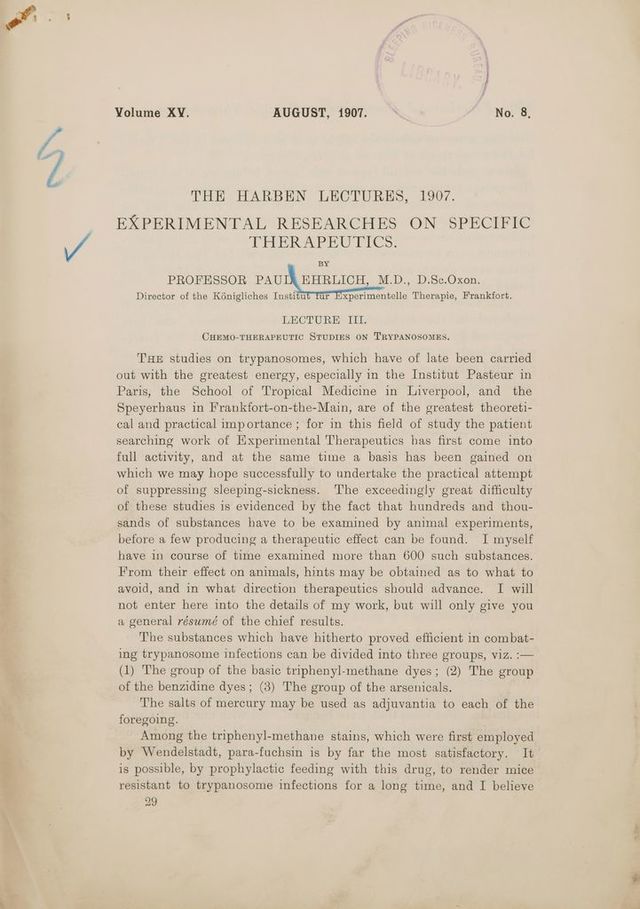
Experimental researches on specific therapeutics. Lecture III, Chemo-therapeutic studies on trypanosomes / by Paul Ehrlich.
- Paul Ehrlich
- Date:
- 1907
Licence: Public Domain Mark
Credit: Experimental researches on specific therapeutics. Lecture III, Chemo-therapeutic studies on trypanosomes / by Paul Ehrlich. Source: Wellcome Collection.
10/10 page 456
![effect 1s inferior to that of quinine. On the ground of our recent experience one would, I think, be perfectly justified in attempting to re-inforce the attack on the malaria parasites by employing combined doses of quinine and methylene blue. Having now reached the end of my lecture, will you allow me once more to call your attention to the fact that the importance of these trypanosome studies 1s a twofold one; first, for theoretical reasons, because they afford us a deep insight into the finest mechanism of the action of the drugs; and second, for practical reasons, since by the methods of research employed and especially by the development of the combined treatment, the way has been prepared for a successful fight against trypanosome diseases. At the same time we are also justified in hoping that even beyond these narrow limits the studies may prove generally fruitful in the creat campaign against infectious diseases. ON THE TREATMENT OF TRYPANOSOMIASIS BY ATOXYL, FOLLOWED BY A MERCURIC SALT. THE main experiments were conducted on white rats with Trypanosoma brucei. If animals at the height of infection were injected with atoxy]l, the trypanosomes rapidly disappeared from the blood, but in 110 out of 113 cases the parasites subsequently reappeared in the blood. The authors’ hypothesis is, that the administration of the drug causes the parasites to pass into ‘‘ an encysted or a passive form, which is no longer attacked by the drug’; this passive form might then under altered conditions develop back into the active form and cause recurrence of the disease. It was assumed that one drug might be especially poisonous for the active, another one for the passive form. Working on these lines, they tried a number of different salts of copper, silver, lead and mercury, but found only the latter to have any effect. By treating nagana-infected rats with an injection of atoxyl at the high tide of infection, and a second dose shortly after, the parasites were removed from the blood; mercuric chloride, or Donovan’s solution, was then administered, with the result that of twenty-five rats, seventeen survived, whilst only two died of trypanosomiasis, the remaining six from some other complication. The chemical part of the paper deals with the constitution of atoxyl, which is considered to be not an anilide, but a sodium salt of an organic acid containing an amidogen group and an arsenic radical directly united to a benzene ring. All experiments should be made with freshly pre- pared atoxyl solutions, as older ones, especially if exposed to the light, undergo decomposition and become more poisonous to the host, and less active against the parasite—(B. Moorr, M. Nimrenstern and J. L. Topp, Bio-Chemical Journal, 1907, No. 5/6, p. 300.)](https://iiif.wellcomecollection.org/image/b3345257x_0010.jp2/full/800%2C/0/default.jpg)