Researches on morphine. Pt. 2 / by S.B. Schryver and Frederic H. Lees.
- Samuel Barnett Schryver
- Date:
- [1901]
Licence: In copyright
Credit: Researches on morphine. Pt. 2 / by S.B. Schryver and Frederic H. Lees. Source: Wellcome Collection.
11/22 (page 571)
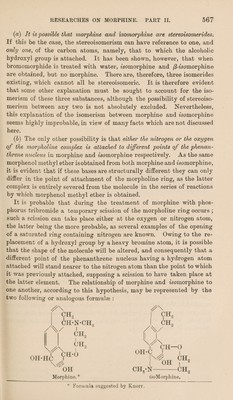
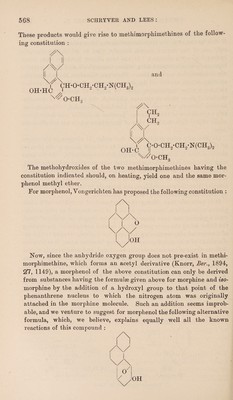
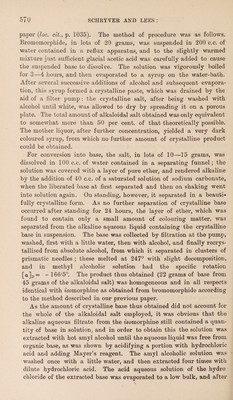
![several additions of alcohol, further evaporated, when suddenly the whole formed a crystalline cake ; this was mixed with alcohol and collected at the pump. The crystalline hydrochloride thus obtained weighed 8 grams when dry ; it was recrystallised from water and separated in rounded clusters of prismatic needles. On determining its specific rotation in aqueous solution, the following result was •obtained : aD= — 4°32'; 1= Idem.; c = 2*257 ; [a]i>10= -200*8°. The aqueous mother liquor from the recrystallised salt was distilled with several additions of alcohol in order to eliminate the greater por¬ tion of the water, and a solution in alcohol was thus obtained from which the salt easily crystallises almost in its entirety. This further ■crop of crystalline product was collected, dried, and its specific rotation •determined, with the following result : aD= — 2°40'; 1= Idem.; c=l*358; [a]iT= -196*4°. It is thus apparent from these numbers that this hydrochloride is a homogeneous product, and that it differs from the hydrochlorides of either isomorphine or morphine, which have respectively the specific rotations [a]o0O= - 150° and - 111*5°. Analyses of the hydrochloride recrystallised from water and (i) dried in the steam oven, (ii) dried in the air, were made, with the fol¬ lowing results : 0*1542 gave 0*3608 CO., and 0*0895 H20. C = 63*8; H = 6*4. 0*1272 „ 0*2974 C02 „ 0*074 H20. C = 63*7 ; H = 6*5. C17Hlf)03N,HCl requires C = 63*5; H = 6*2 percent. /3-iso Morphine was obtained from the hydrochloride by suspending it in alcohol, and slowly adding a dilute solution in alcohol of one atomic equivalent of sodium. The hydrochloride quickly dissolved, and after removal of the sodium chloride, the alcoholic solution was concentrated, filtered from a further small amount of sodium chloride which had separated, and somewhat further concentrated, when a glistening, crystalline base was deposited. This was collected and recrystallised from hot alcohol, in which it is only moderately soluble, and from which it separates in well-defined, double, rhombic pyramids. When heated in a capillary tube, the base assumed a softened appear¬ ance at 145—150°, but was otherwise permanent until 182°, when it melted sharply without decomposition, and this behaviour on heating was not altered after the base had been recrystallised several times from alcohol. On analysis, the following numbers were obtained : 0*1755 gave 0*447 CC2 and 0*1115 H20. C = 69*5 ; H = 7*l. In view of the singular behaviour of this base on heating, and of](https://iiif.wellcomecollection.org/image/b30600686_0011.jp2/full/800%2C/0/default.jpg)