Researches on morphine. Pt. 2 / by S.B. Schryver and Frederic H. Lees.
- Samuel Barnett Schryver
- Date:
- [1901]
Licence: In copyright
Credit: Researches on morphine. Pt. 2 / by S.B. Schryver and Frederic H. Lees. Source: Wellcome Collection.
14/22 (page 574)
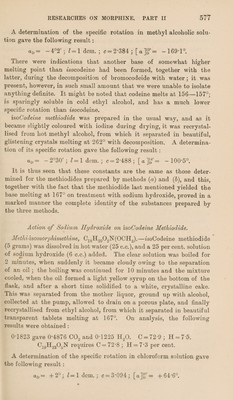
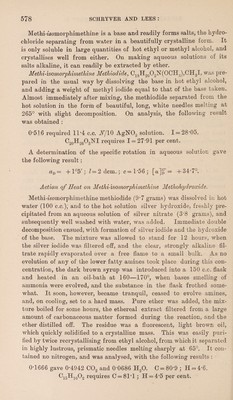
![with ether, and the ethereal solution dried and concentrated, a white, sandy, crystalline base was deposited, which proved to be bromomorphide, as it melted at 170° with decomposition, and in methyl alcoholic solution had a specific rotation of + 68°. aD = + 2°36'; 1 = 2 dcm.; c=l‘898; [a]D= +68°. Action of Hydrobromic Acid.—As might be expected from the result of the last experiment, «somorphine, like morphine (compare previous paper, loc. cit., p. 1034), when treated with hydrobromic acid, yielded bromomorphide. Action of Phosphorus Trichloride.—isoMorphine (5 grams) was treated with phosphorus trichloride in a manner exactly analogous to that de¬ scribed for morphine in our previous paper {loc. cit., p. 1029), and the resulting light brown varnish disintegrated with iced water. The acid aqueous solution, made strongly alkaline with sodium carbonate, was ex¬ tracted six times with chloroform, this chloroform solution washed with water, dried over calcium chloride, and the solvent distilled off. A small amount of a yellow syrup was obtained which showed no signs of crystallising even after long standing, but seemed to decompose readily when any attempt was made to form a methiodide. Its solution in organic solvents seemed to undergo oxidation readily, giving coloured solutions not dissimilar to those given by apomorphine under the same conditions. Although this reaction was carried out several times and under varying conditions, in no case could any chloromorphide be isolated from the products of the reactions, thus showing that ^'somor- phine does not resemble morphine in its behaviour with phosphorus trichloride. iso Codeine Methiodide. isoCodeine Methiodide, Cl7H1802N(0CH3),CH3I, was prepared by the three following methods. (a) From iso Morphine Methiodide.—To a solution of methiodide (5*6 grams) in hot water (150 c.c.) was added a hot aqueous solution of silver sulphate (2T grams = 1J mol.). Double decomposition immediately ensued with precipitation of silver iodide, which was separated by filtration at the pump, after the mixture had been boiled for some minutes. To the hot filtrate an aqueous solution of barium hydroxide [2 5 grams Ba(0H)2,8H20 = \ mol.] was added, the mix¬ ture heated to boiling, and carbon dioxide passed through for some minutes to precipitate any slight excess of barium. After filtration from barium sulphate, the clear, strongly alkaline, aqueous solution of the basic hydroxide was concentrated to 50 c.c. on the water-bath, and then placed in an exhausted desiccator over sulphuric acid. In this way, a light brown, solid cake was formed, which was readily powdered.](https://iiif.wellcomecollection.org/image/b30600686_0014.jp2/full/800%2C/0/default.jpg)